Where it began
It began on the crater rim of La Soufrière, the volcano that makes up the north end of St Vincent, a hundred miles west of Barbados, where I grew up. Three generations of my family have climbed it, and as far as I know nobody has fallen in yet, though not for want of trying.
My uncle Bruce went first. He was sixteen, a Lodge School boy on his Easter holidays in the early 1960s, staying with his uncle Cecil, my great-uncle, opposite Young Island. He and his cousin Joe were sent up the mountain with a party of middle-aged tourists and given the rum punch to carry. They were soon well ahead of everyone, and lighter by a sip or two of the punch. At the top there was no cloud at all. The summit was waist-high scrub, the trail had disappeared, and Bruce stepped carefully towards what he took to be the edge. It wasn't the edge: the bushes grew out over the drop. His foot, in his words, "punched through the sky". He threw his elbows back, caught the lip of the crater under his shoulders and hauled himself out, having had a good long look at a blue lake several hundred feet below.
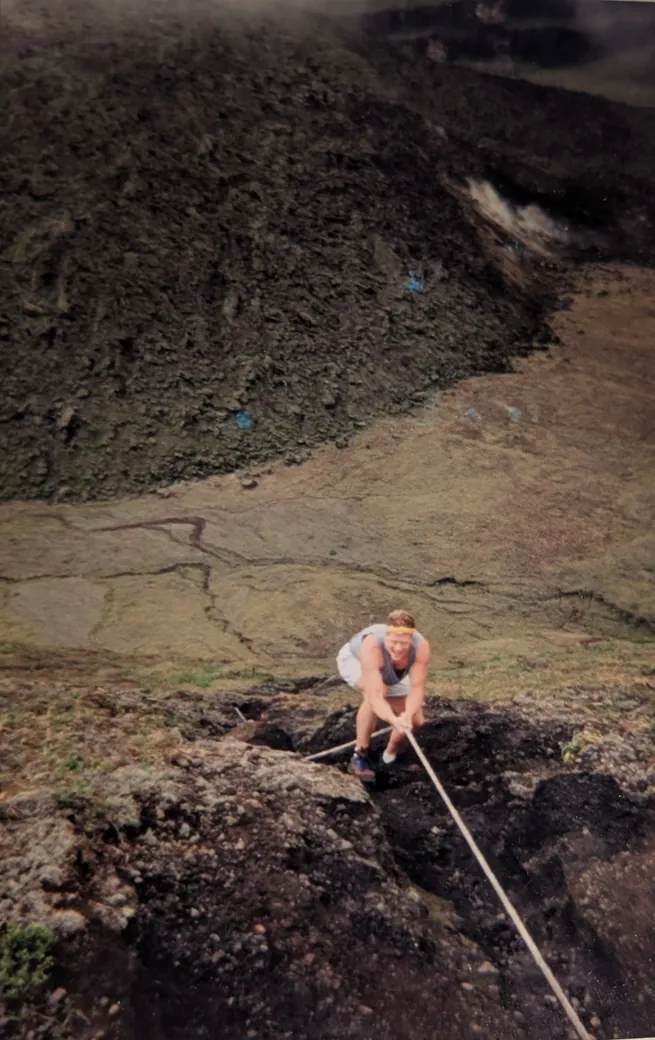
I went in 1996, in my twenties, with my old college friend and roommate John Bennett. We had bananas and some water, and that was it. We set off before dawn, left a rental jeep at Richmond Beach on the leeward coast, crossed a little river and climbed from sea level up along the line of an old lava flow. The summit was in cloud. On the rim we found a rope tied to steel rings, running down into the crater. That's John testing it in the photograph at the top of this page, and we decided against it. We walked a little way round the rim, saw steam rising and strangely coloured rock, and turned back when the cloud closed in.
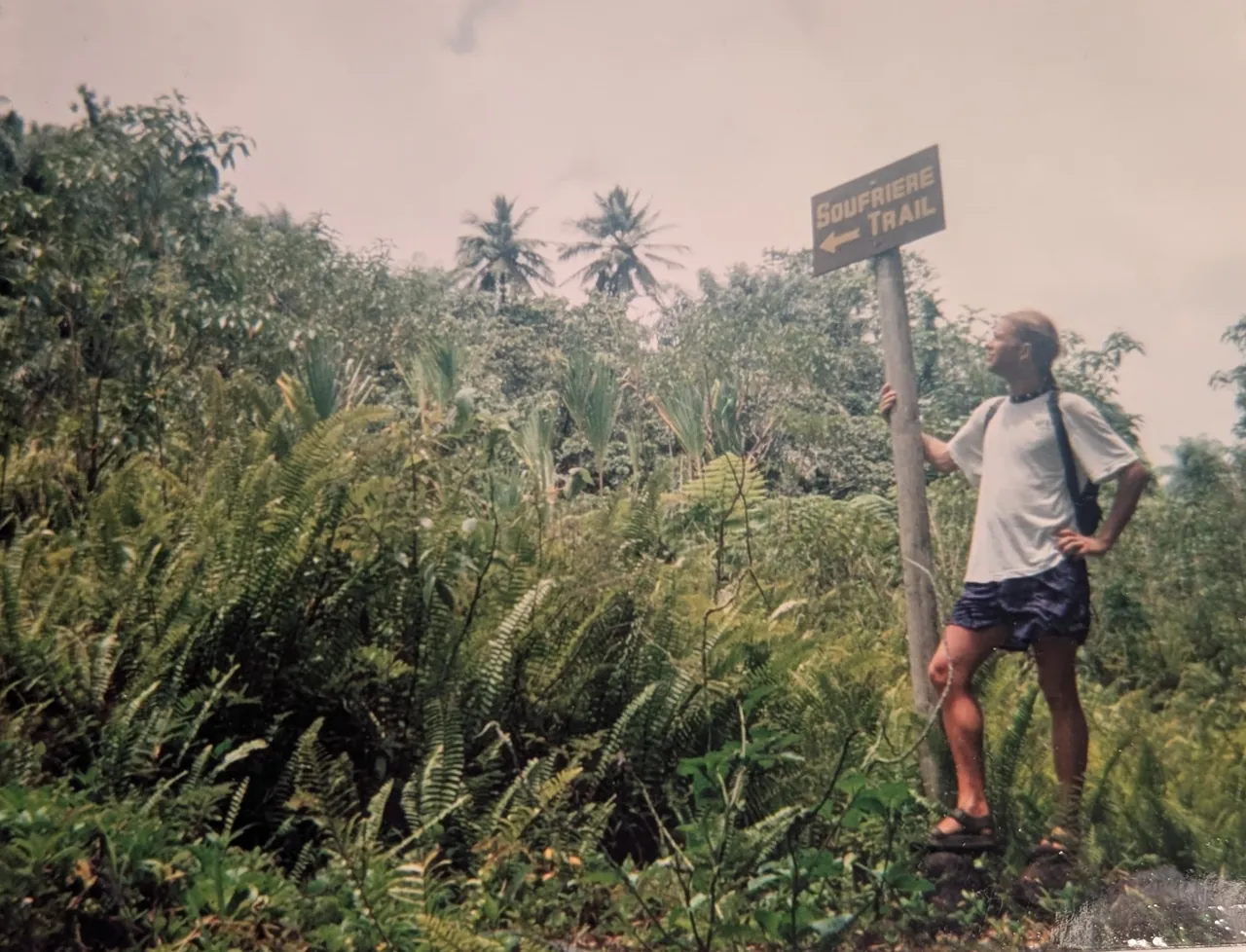
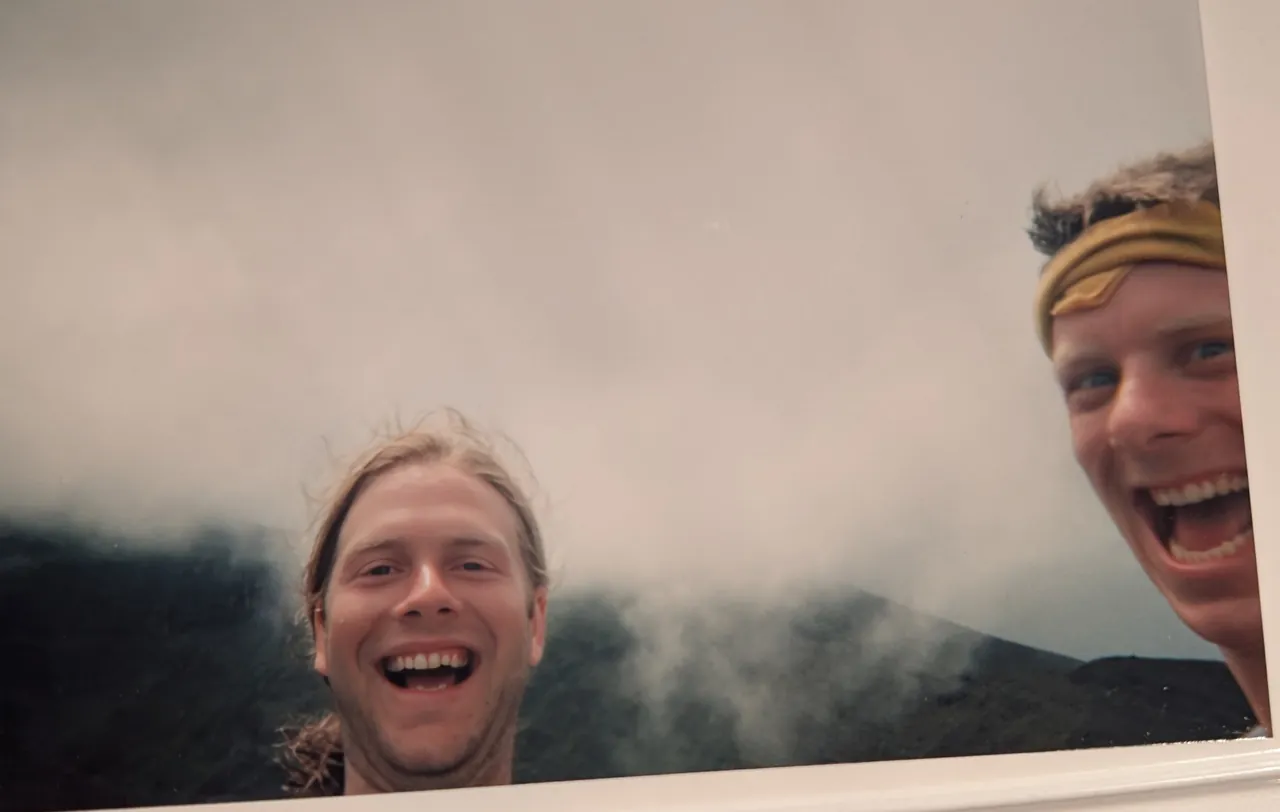
I went again in April 2014, in my forties, on a family passage aboard Ecstasy, the Goddard family's wooden yawl, from Barbados down to St Vincent, and then on through the Grenadines. We crossed overnight, caught a bonito and a barracuda on the way, and anchored off Young Island, the same bay where Bruce had stayed and where John and I had stayed. A minibus took us up the windward coast, past the new airport then being built at Argyle, to a trailhead near Orange Hill, where Bruce had started half a century before. We walked up through the rainforest, into scrub and then into the clouds. This time the cloud kept lifting, and we spent a long while looking down at the plug of lava on the crater floor. My brother Roger both made and carried the rum punch, his own Cutters recipe. Charles Herbert, who married into the family, wrote up the whole voyage afterwards.
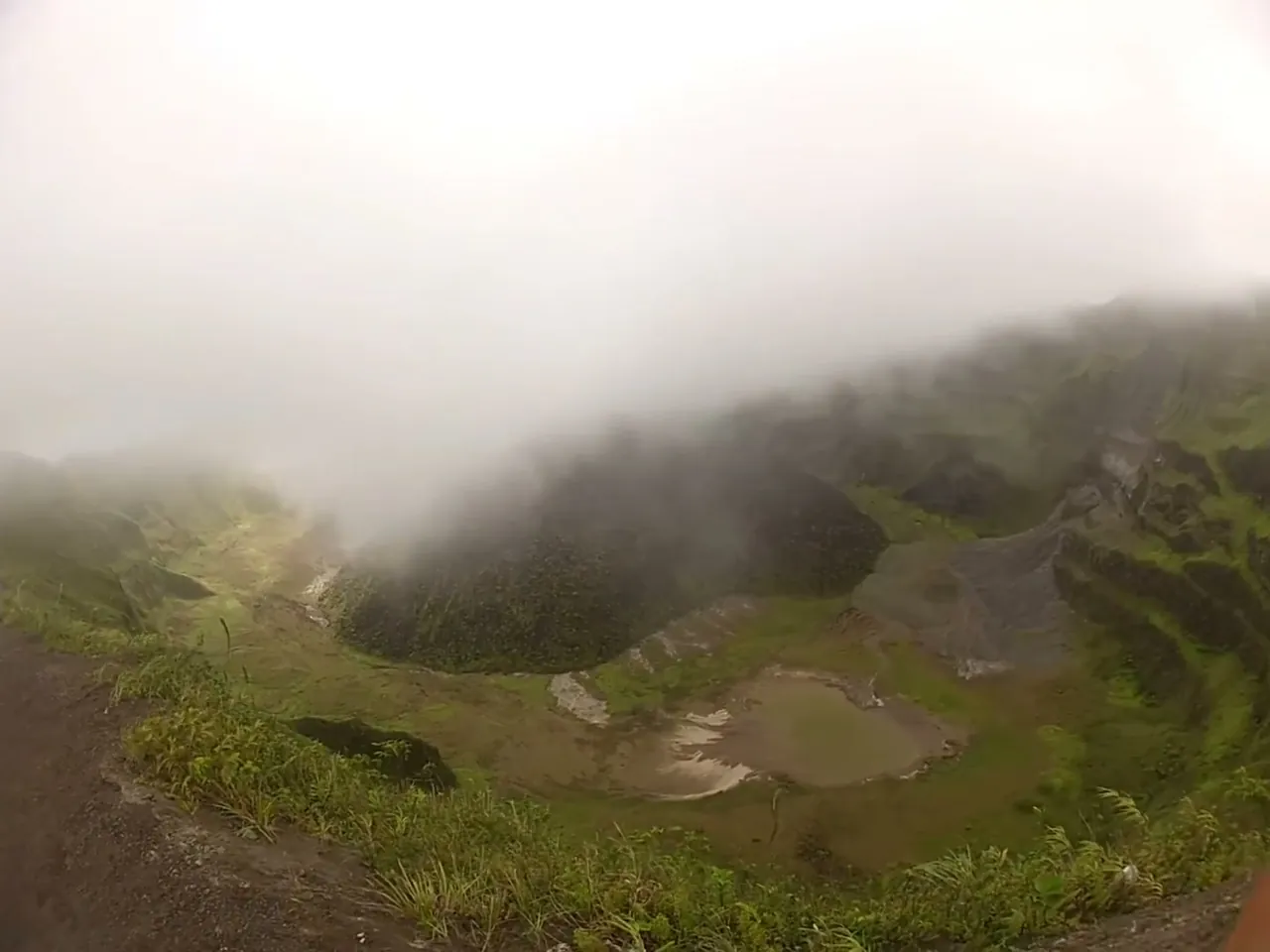
The mountain did not wait for us. It erupted on Good Friday 1979, between Bruce's climb and mine, and again in 2021, when it dropped ash on Barbados.
I was taught at school that Barbados was coral, lifted by "earth movements". That phrase was doing a lot of work. The textbook was not lying to me: it had the sequence right and the cause missing, and it was written a decade after the argument had in fact been settled. That gap, between what was known and what was taught, is where this series started.
How it is made
- i.Every voice you hear is human. The narration is mine; the historical quotations are read by people, several of whom went out of their way to help. The instrumental music is composed with Suno, which is stated plainly in the credits of every episode.
- ii.Quotations are checked against primary sources, and each episode's page lists every one of them with its status and source. Where a passage is paraphrased, the narration says so out loud.
- iii.Wegener's critics are not villains. He was right about the what and wrong about the why, and in science the why is not a nicety.
How these rules were learned, including two quotations that turned out not to exist, is in the Acknowledgements.
The voices
The historical quotations are read by voice actors, cast by accent and era. An Archbishop of Armagh ought to sound like one, and Kelvin and Rutherford, who share a scene, ought not to sound alike.
Most of them I found on Fiverr, and I would recommend it to anyone making something like this. An independent series with no budget found experienced professionals — Jon has thirty years in broadcasting, Alex more than thirty in voice-over — who read a sentence or two of history with real care. My experience with every one of them was great. John Cowan, who read Rutherford, is a story of his own, told in the Acknowledgements.
Jane
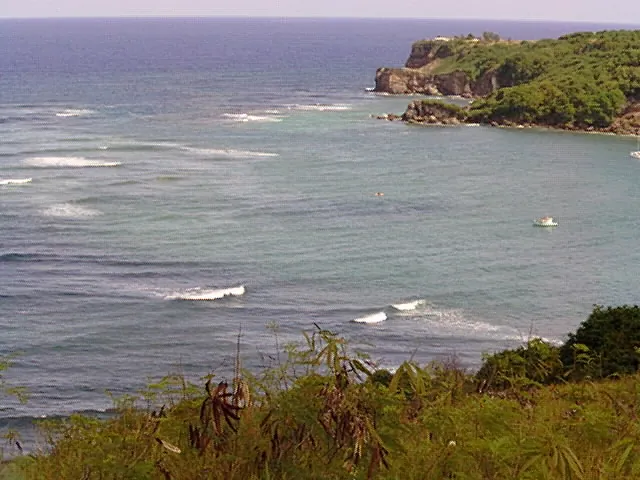
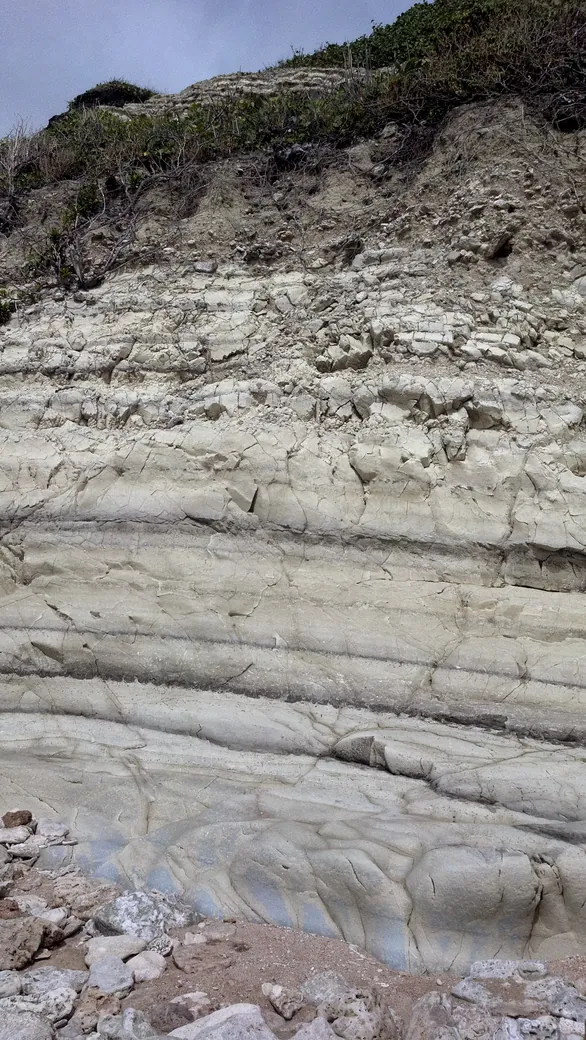
None of this would exist without my wife, Jane. She was with me in those early days at Consett Bay, walking the hillsides, when we met Bob and Christine Speed. Episode 0 is about that stretch of coast, where two very different kinds of rock meet and join. Around the same time, Jane and I were married in Barbados, joining our own lives, so I have my own reasons for thinking of it as a place where things come together.
She has been part of every stage since; more on that in the Acknowledgements.
Listen
The Slow Machine is on Apple Podcasts, Spotify and Amazon Music, and in any other podcast app through its RSS feed. Paste the address below into your app's "add by URL" option if it doesn't find the show by name.
https://theslowmachine.com/feed.xmlCorrections & correspondence
I am not a geologist, and I have done my best to get this right. If you are one, or you simply know something I don't, I would love to hear from you. Corrections are especially welcome, and so is a note to say which episode you enjoyed, or where in the world you were listening.
There are no comments here, so please write to me at michael.goddard@theslowmachine.com. I read every message, and I will do my best to reply.