The Slow MachineThe View from a Small Island
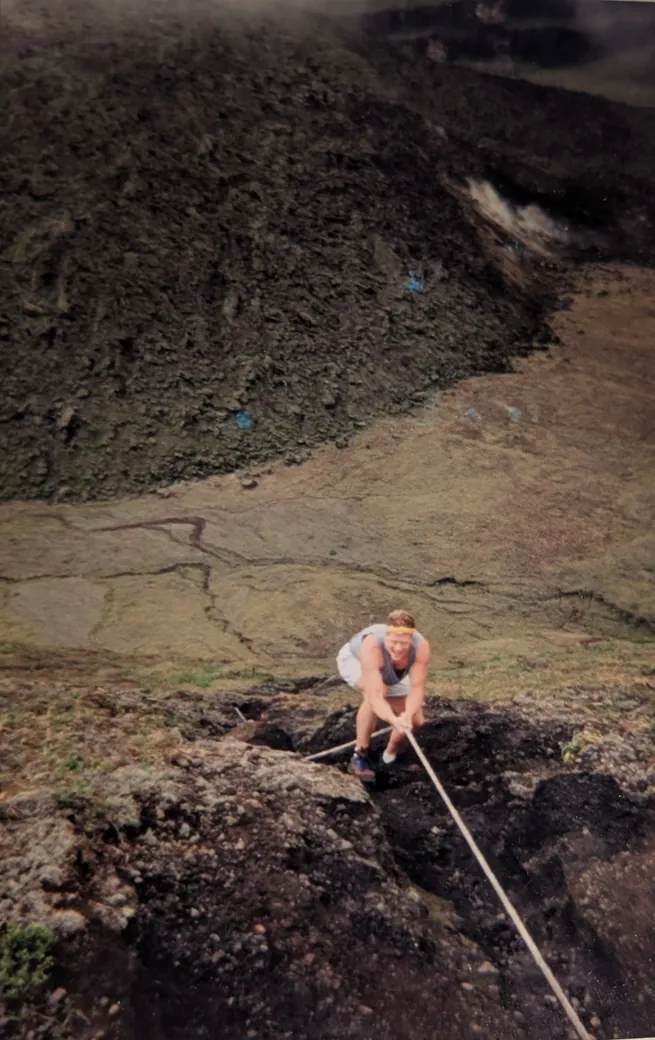
There is a volcano in the eastern Caribbean called Soufrière.
There are several, actually. It is the French word for a sulphur vent, and it got handed out to half the mountains in the island chain. But the one I mean is on St Vincent, and I have stood on the rim of it twice.
Once in my twenties. Once in my forties.
You come up through rainforest. It gives way to scrubby shrubs, and then to cloud. The last part is loose underfoot, and then the ground simply stops. There is a hole in it. And the hole is smoking.
I have never been able to say properly or describe what that is like but it made a deep impression on me.
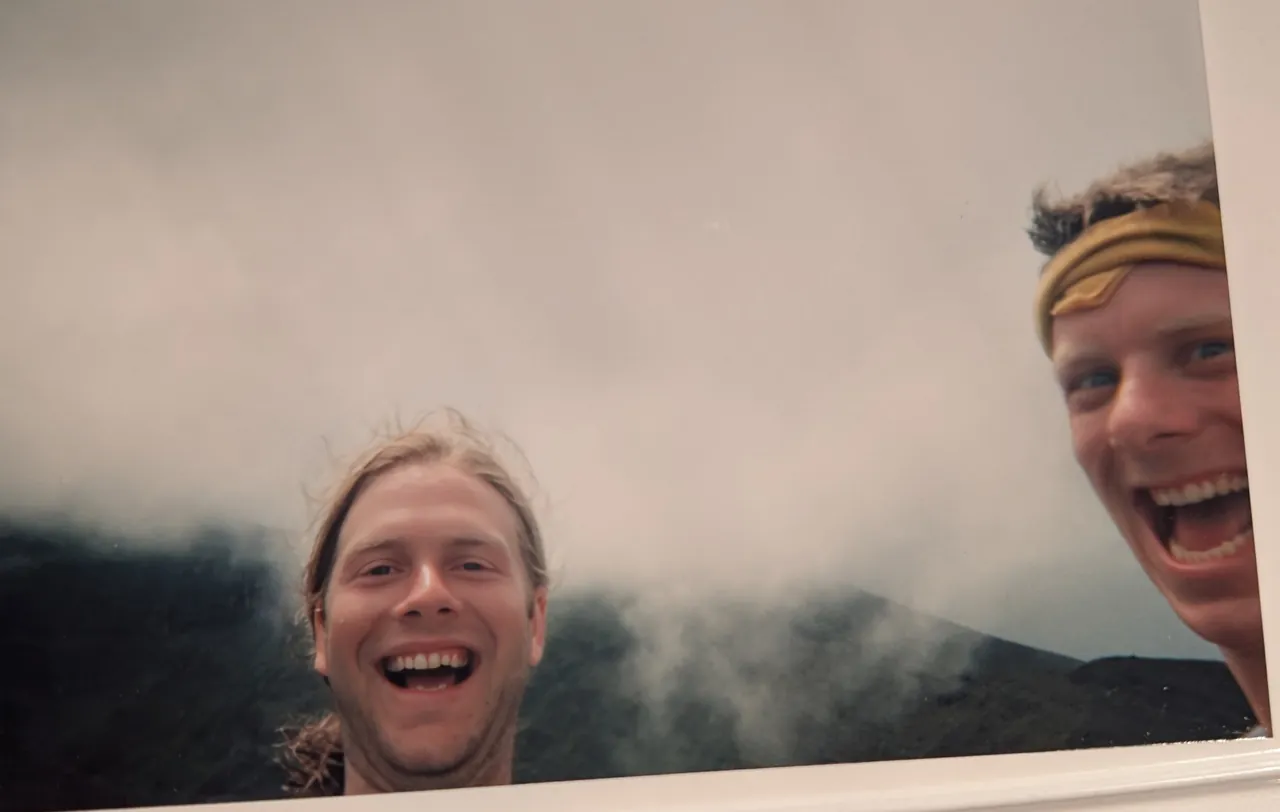
My uncle Bruce climbed that same mountain as a teenager, a generation before me.
In 1979, on Good Friday, it erupted. I remember that one.
In 2021, it erupted again, and put ash once more into the upper atmosphere, catching the anti-trade winds, travelled east and rained down, covering Barbados in Soufrière dust.
So: three climbs, two eruptions, one family, one hole in the ground.
Sixty-odd years of us going up there to look into a thing that has no interest in us whatsoever — that was working long before any of us, and is not finished, and will still be working long after.
That gap — between how long we last and how long the ground takes — is what this series is about.
This is The Slow Machine. I'm Michael Goddard.
§ I
A Phrase I Never Questioned
I was raised on Barbados, a small coral island sitting out on its own to the east, outside the arc of our volcanic neighbours.
Every Barbadian learns about its formation in school, and the story I learned went something like this.
Sediment washes off the Orinoco and other rivers of South America, settling on the deep ocean bed. It builds up, layer on layer, until it reaches sunlit water. Corals take hold and grow. And then there were earth movements, which lifted it — and more coral grew on top, and it was lifted again, in a stair-step fashion, until it became the island that exists today.
Earth movements.
I must have written that phrase in a school exercise book a dozen times, and I never once asked what an earth movement actually was. Neither did anybody else. It was in the textbook.
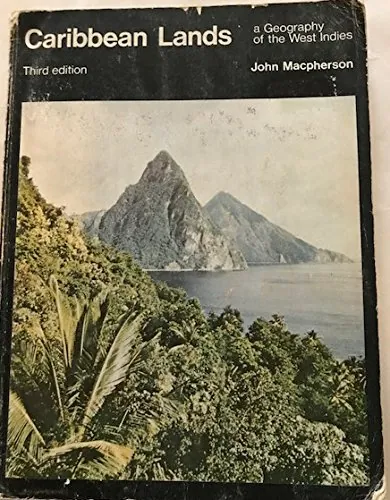
The textbook was Caribbean Lands: A Geography of the West Indies, by John Macpherson. It was first published in 1963, and it is what we still learned from in the 1970s and the 1980s.
Here is what I did not know.
In June 1968, a young French geophysicist called Xavier Le Pichon took the surface of the entire Earth, divided it into six rigid pieces, worked out how fast each one was turning and about what point — and then checked every single boundary against every other one to see whether the maths came out.
And indeed, the sums added up.
That was the end of an argument that had been running for sixty years, and had ruined at least one career and probably killed a man. After June 1968, we knew what an earth movement was.
The surface of the Earth is broken into a few enormous pieces, and they are moving. An earth movement is what happens where two of them meet.
And I was sitting in a classroom on a coral island, ten, fifteen and twenty years later, reading a book that didn't.
§ II
The Book Was Not Lying to Me
Now, I want to be careful here, because it would be very easy, and completely wrong, to be smug about that.
That textbook was not lying to me. Look at the story again. Sediment, then coral, then uplift, then more coral. Every part of that sequence is still true, and it is still what you would tell a child today.
What it did not have was the cause. It had the what, and not the why.
And you are about to spend nine episodes finding out that having the what and not the why is the most dangerous place in science to stand.
It is exactly where a German meteorologist named Alfred Wegener stood for twenty years, and it is what destroyed him — not because his critics were fools, but because they were doing their jobs.
So this series is not a story about clever people replacing stupid ones. I have no patience for that version. It is a story about how a thing gets from probably to certainly, and how long that takes, and how much of it happens by accident.
§ III
The Man on the Hillside
Somewhere around 1998, walking the hillsides of Consett Bay in Barbados where I then lived, I met a geologist called Bob Speed, and his wife Christine.
And it matters where we were standing, although I had no idea of that at the time.
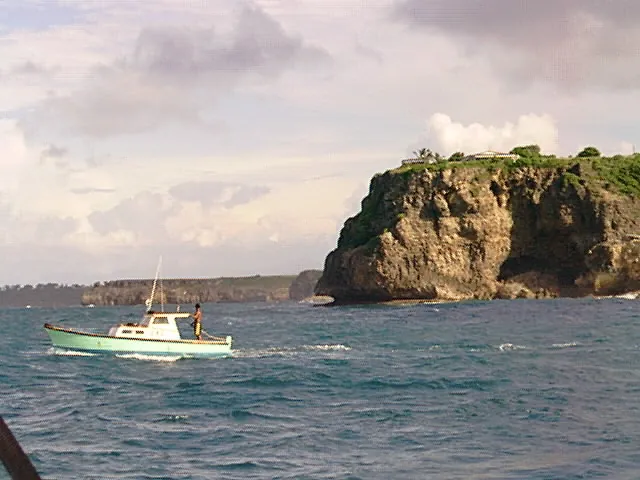
Look south from Consett Bay and there is a tall coral cliff standing over the Atlantic breakers. Look north, towards Bath, and there are chalky hills of an entirely different kind of rock, running away up the coast.
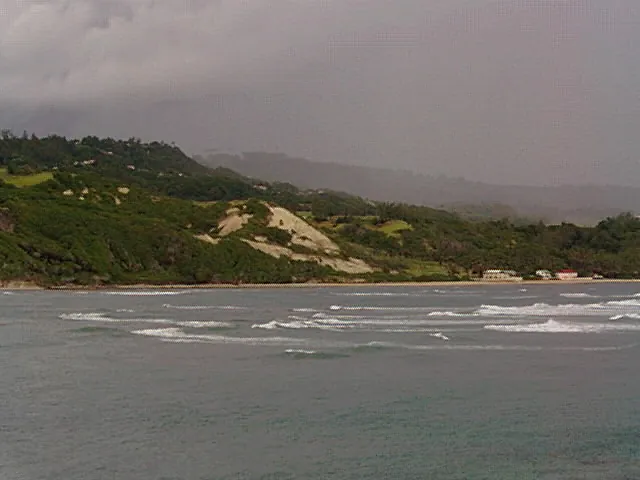
Two different worlds of stone, meeting in a place you can walk across in an afternoon.
I had been walking past that junction my whole life.
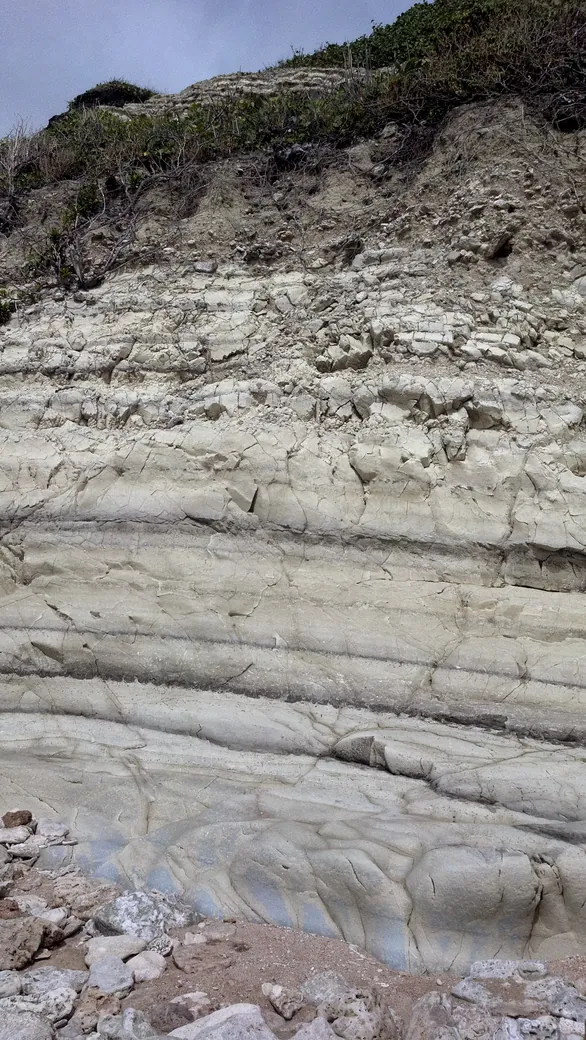
Bob was an American, and he had been coming to our island for about thirty years, and what he did there was walk it. Measure it. Collect samples from it. Ask questions about it, patiently, for three decades, on foot.
He died in 2003.
And in 2021 — eighteen years after he died — a book of his came out called Emergence and Evolution of Barbados, finished by a colleague and his wife, which is the modern account of how my island came to exist.
I bought it. I read it. It was hard going for me, and I had to keep going back over it, because I am not a geologist. I want to be honest about that, because it is the whole reason this series sounds the way it does.
And here is what Bob Speed and the people who came after him worked out, which nobody could have told me at school.
Bob Speed does not do metaphors. The writing is as plain and as technical as writing gets — and here, on the third page of an earlier book of his, Geology and Geomorphology of Barbados, is what my island is.
Robert C. Speed, read by the narrator1Barbados is a peak on the Barbados Ridge... The Barbados Ridge is an accretionary prism consisting of deformed sedimentary rocks — the detrital and pelagic cover of the Atlantic basin — that underwent horizontal shortening, vertical thickening, and accretion to the hanging wall of the subduction zone between the South American and Caribbean plates.
1 · VerbatimRobert C. Speed, Geology and Geomorphology of Barbados, ed. Christine Speed and Richard Sedlock, Geological Society of America Special Paper 491 (2012), pp. 3–4. The quotation begins on p. 3 and runs onto p. 4. Book confirmed by Michael against the printed copy, 2026-10-07
Now, that is not showing off. Every word of it is load-bearing, and to a geologist it is complete and exact.
It is also, if you are me, a wall. I read it four times.
So let me tell you what it says, because it is the best thing I have ever learned about my own home.
Out to the east, the floor of the Atlantic is travelling west. Where it reaches the Caribbean, it goes down underneath it.
The hard rock at the bottom goes down with it. But the mud on top — the dust and the shells and the silt of an entire ocean, laid down over tens of millions of years — does not go down easily. It gets shoved.
Think about pushing a rug across a floor into a wall. The rug does not slide under the skirting board. It shortens. It rucks up into folds. It gets thicker.
Horizontal shortening. Vertical thickening. That is all that sentence is saying.
So Barbados is a rug of old Atlantic sea bed, shoved west, wrinkled up and thickened — with a coral reef grown over the top of it, and lifted into the Caribbean sunshine.
And now listen again to how Bob's sentence starts. He does not call Barbados an island.
He calls it a peak. On a ridge.
My island is the top of a mountain range, and almost all of that range is still underwater. The part that is not is where I grew up, and the highest point of it stands one thousand one hundred and fifteen feet above the sea.
And the volcano — a hundred miles to the west — is the other thing that happens when a sea floor goes down. Deep enough, and hot enough, and it melts what is sitting above it.
So the ground I grew up on and the mountain my uncle climbed as a boy are two outputs of one machine, about a hundred miles apart.
Nobody told me that, because when my textbook was printed, nobody knew.
One more number out of Bob's book, and then I will leave him alone.
The plate carrying the floor of the Atlantic is moving due west at twenty millimetres a year.
Twenty millimetres. Two centimetres. That is roughly the rate your fingernails grow — and it is the entire budget. All of it. The shoving, the wrinkling, the lifting, the melting, the island, the volcano.
Everything I have just described is being paid for at the speed of a fingernail.
§ IV
Other People's Tools
Which brings me to what this series actually argues, and why I think it is worth nine episodes of your time.
The house I grew up in had a big atlas. It sat on a coffee table, and it had maps of everything — industrial production, agriculture, fisheries, shipping — and I read it the way other children read stories. There were National Geographic magazines in the house too going back to the early 1960s. This was before the internet. That was the window.
None of that was made for me. It was made for commerce, and planning, and journalism, by people I will never meet, for reasons of their own. I used it to see the world anyway.
And that, it turns out, is the entire story of how we learned the Earth moves.
Surveyors measuring India so an empire could tax it, found out that mountains have roots.
Two brothers built an instrument to study squeezed crystals — and Marie Curie took that same instrument and pointed it at uranium ore and found radium, and radioactivity destroyed the known age of the world.
Machines built to hunt submarines mapped the bottom of the sea, and found a mountain range forty thousand miles long running right round the planet, with a split down the middle of it. And a telephone company, worrying about its cables, produced the map that proved the split was alive.
A Nobel Prize-winner built the most sensitive magnetometer on Earth to prove his own law of nature, disproved himself, and handed over the leftover instrument — which is the one that read the magnetism frozen inside ordinary rock.
And a global network of listening posts, buried in sixty countries so that two governments could sign a treaty about nuclear weapons, found the place where the sea floor goes to die.
Not one of those instruments was built to answer the question it answered.
Geology's revolution was not made by geologists thinking harder. It was made by people in other fields, using instruments built for other jobs, who noticed what they were looking at. Other people's tools.
§ V
What Is Coming
Over nine episodes you are going to get an archbishop who dated the creation of the world to a Saturday evening in October. An apple left on a windowsill, which was for seventy years the best available explanation for the Himalayas. A man lying under a metre of Greenland snow with his skis planted upright over him.
A woman who drew the shape of the bottom of the ocean and was not permitted on the ships that collected the data.
A rejection letter calling one of the most important ideas of the century the sort of thing people say at cocktail parties.
And a chart you can fold down the middle, where both halves land exactly on top of each other, and the argument is over.
And every bit of it runs at the speed of my island. A couple of centimetres a year.
That is the rate the Atlantic is getting wider. It is also the rate at which the Atlantic was made.
Give that enough time and it will open an ocean, raise the Himalayas, and carry a small tusked reptile from a tropical swamp to the South Pole.
§ VI
Not an Edge
I said at the start that small islands are strange places.
They are insular, literally — cut off. And for some people that becomes a reason to stop wondering. But for a certain kind of person it does the opposite: you grow up with the horizon very close and very visible, and you spend your childhood wanting to know what is on the other side of it.
I got out and had a look.
And what I have got out of years of reading for this, and out of Bob Speed's difficult book, is not really a set of facts about plates.
It is this. It can be healthy to question what you already know, and to ask why you know it. And to walk about on this earth and look at it directly, is not a small thing. It is how every single person in this series found out what they found out.
I am not the one collecting the rocks. I am not using the mass spectrometers. But I can carry the work of the people who did a little further along, to somebody who has not heard it — and if that reaches the next curious person, then it was worth doing.
One last thing.
The island I grew up on is not a small thing sitting on top of the Earth.
It is the Earth itself, standing up — pushed out of the sea floor by the same process that lit the mountain my uncle climbed as a boy, and that I climbed twice, and that went off again in 2021.
So perhaps the thing I have actually learned is this.
I am not just an island boy.
I am a child of the Earth.
The Slow Machine. Nine episodes. Next up, episode one — "Before the Question."
The series lives at theslowmachine.com. Every episode has a page there with the full transcript, and a table of every quotation in it with the source it came from. If you would like to write to me, the address is michael.goddard@theslowmachine.com.
Apparatus
Quotations, and where they come from
1Speed — "Barbados is a peak on the Barbados Ridge... The Barbados Ridge is an accretionary prism..."Verbatim, read by the narrator — NOT by a guest voice. Two sentences joined by an audible ellipsis. Narrator-framed out loud, naming the book ("here, on the third page of an earlier book of his, Geology and Geomorphology of Barbados, is what my island is"), so the listener knows it is quoted and where from. Checked against the book by Michael, 2026-09-15: the text reads "a peak".Robert C. Speed, Geology and Geomorphology of Barbados, ed. Christine Speed and Richard Sedlock, Geological Society of America Special Paper 491 (2012), pp. 3–4. The quotation begins on p. 3 and runs onto p. 4. Book confirmed by Michael against the printed copy, 2026-10-07
—No other quotation in this episode—Deliberate. Ep 0 is the only episode that is entirely Michael in his own person rather than Michael as narrator, and a guest voice would break that. The Speed sentence is read by Michael himself precisely so that holds; every other figure named here is described, never quoted