The Slow MachineThe Shrivelling Apple
I want you to do something this week. Buy an apple, and don't eat it.
Put it on a windowsill and leave it there for a month. What happens is this: the flesh inside slowly loses water and shrinks. The skin can't shrink as fast, because skin doesn't work that way. So the skin ends up too big for what's underneath it — and it puckers. It goes into ridges and folds and wrinkles.
For about seventy years, that apple was the best available scientific explanation for the existence of the Himalayas.
This is The Slow Machine. Episode two: the shrivelling apple — and the fossils that ate it from the inside.
§ I
A Cooling World
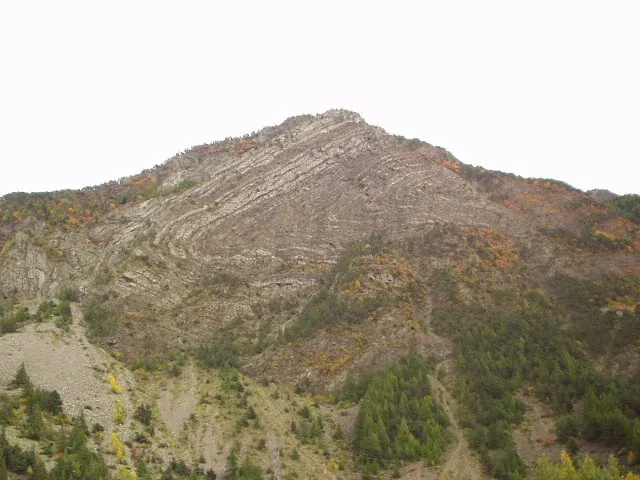

Last episode we left James Hutton having just cracked open deep time. The Earth is old — unimaginably old — and there's heat inside it doing work.
The nineteenth century took that and built something out of it, something that was clean and simple and mathematical, which is exactly what a young science craves.
The reasoning went: if there's heat inside the Earth, where did it come from? Obvious answer — the planet formed hot. A ball of molten rock, spun off or condensed or however you liked, and ever since, it has been doing the only thing a hot object in cold space can do. Losing heat. Cooling.
And here's the key step. Things that cool, contract. Heat a metal rod and it gets longer; cool it and it gets shorter. Every engineer in the industrial revolution knew this — it's why bridges have expansion joints and why a blacksmith fits an iron tyre onto a cartwheel hot and lets it shrink tight.
So: the interior of the Earth is cooling, therefore contracting, therefore pulling away from the crust. But the crust is already solid and cold, and it can't shrink to match. It's now too big for the ball underneath it.
So it crumples.
Mountains are wrinkles on a drying fruit. The Alps, the Andes, the Rockies — those aren't features, they're creases, where the skin of the planet buckled because the inside was sagging away from it.
And if that has an echo in it, it should. Two hundred years earlier, Thomas Burnet stood in the Alps and saw wreckage — mountains as the broken evidence of something having gone badly wrong with the world. The Victorians took the theology out and put physics in its place. But look at what survived the swap. The instinct that mountains are a problem. Something the planet suffered, rather than something the planet does.
That instinct is going to take a very long time to die.
This is contraction theory, and I want to be fair to it, because it is genuinely a good theory.
It's simple — one cause. It's quantitative — you can calculate how much shortening you'd get. It explains why mountain ranges are long and narrow rather than blobby, and why the rocks inside them are folded and stacked and shoved sideways, like a rug rucked up against a wall. Anyone who's looked at a road cutting through a mountain range has seen those folds. They are absolutely real, and they absolutely do mean the crust was squeezed horizontally.
Contraction theory said: yes, squeezed — by a shrinking interior.
And it had one more feature that made it irresistible to the Victorians, which is that it required nothing to travel very far. Everything stays where it is. The continents don't go anywhere. The Earth's face ages the way a face ages: it sags and creases, but the nose doesn't migrate to the ear.
§ II
A Clock on the Wall
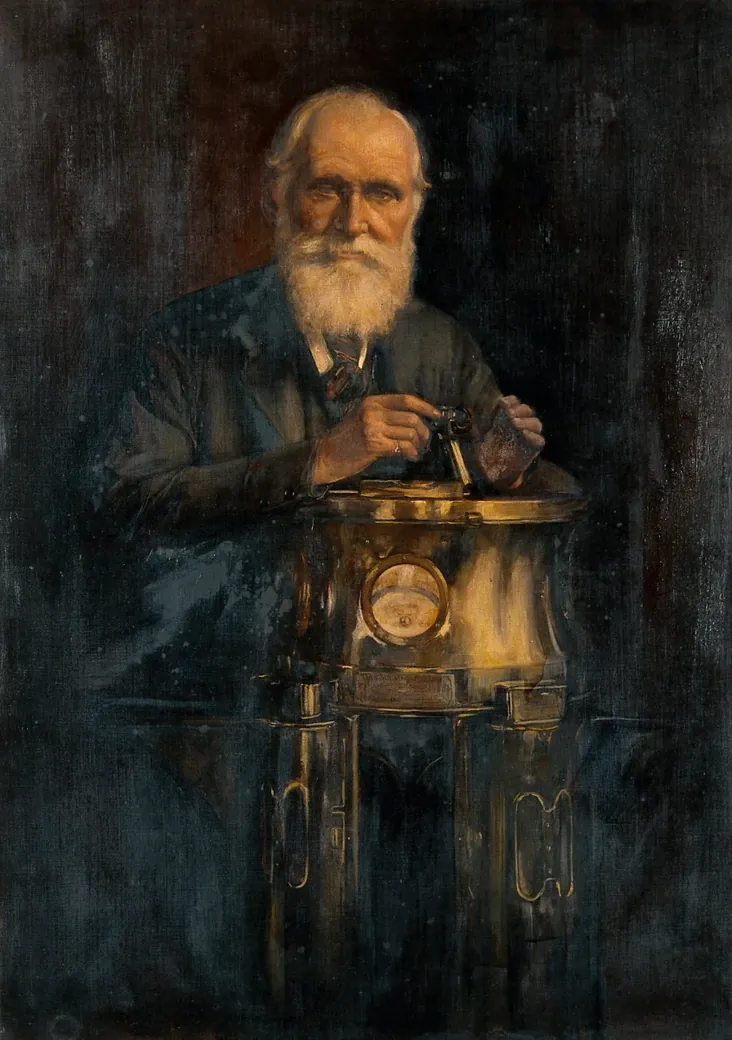

Now, if the Earth is a cooling body, you can do something rather wonderful with that. You can work out how old it is.
This is what Lord Kelvin did, and to understand why his calculation landed like an artillery shell, you have to understand who Kelvin was. William Thomson, Lord Kelvin, was the undisputed monarch of British physics. He had formulated the laws of thermodynamics. He had personally supervised the laying of the transatlantic telegraph cable. There was an absolute temperature scale named after him. When Lord Kelvin did a calculation, it was not an invitation to debate. It was a verdict.
And his calculation was this: Take a sphere of molten rock the size of the Earth. Let it radiate heat into cold space. Measure how fast temperature currently rises as you descend into a deep coal mine — which is a known, measurable quantity. Work backwards.
How long has it been cooling?
His answer, refined over decades, came out somewhere between twenty and a hundred million years — and as he kept working on it, he pushed it lower, toward twenty.
Lord Kelvin, 18971The earth is filled with evidences that it has not been going on for ever, and that there is a progress of events towards a state infinitely different from the present.
1 · Verbatim"The Age of the Earth as an Abode Fitted for Life", 1897 address
Now, geologists hated this. They hated it viscerally.
Because by the 1860s, field geologists had spent half a century wading through rain and mud, examining rock strata thousands of feet thick that had clearly accumulated grain by grain on an ancient sea floor. They had an empirical feel for how long that takes. Their gut said hundreds of millions of years, minimum. Kelvin's arithmetic gave them a fraction of that.
And they could not fight him. This was precision mathematical physics against a bunch of naturalists with hammers. Charles Darwin, whose fledgling theory of natural selection required vast stretches of time for tiny variations to accumulate, was tormented by Kelvin's clock. Darwin privately called Kelvin's number one of his "sorest troubles."2
2 · Verbatim fragmentDarwin — "sorest troubles"Darwin to A. R. Wallace, 14 April 1869
Remember this, because it comes back. Kelvin's mathematics was flawless. Every step checks out. The error was in a single assumption sitting quietly at the very start — an assumption so obvious to everyone alive in 1860 that nobody thought to write it down as an assumption at all.
He assumed the Earth had no way of generating new heat.
We'll come back to that.
§ III
The Face of the Earth
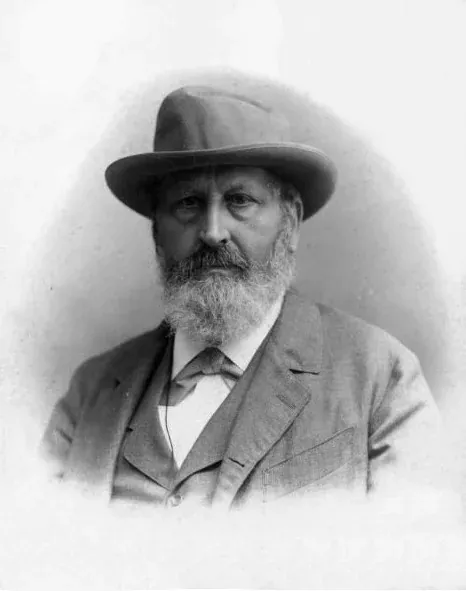

So that's the framework. A cooling, shrinking, wrinkling planet on a fairly short clock. Now let's meet the man who built the definitive version of it — and who, in the process, found the thing that would eventually destroy it.
Eduard Suess was an Austrian geologist in Vienna, but he was far from an isolated academic. He was a practical man devoted to public life. When cholera repeatedly devastated Vienna in the mid-1800s, Suess didn't just study rock samples — he mapped the region's complex geology to design a grand alpine aqueduct, bringing fresh mountain spring water to the city and ending the epidemics for good. He was a statesman, a member of parliament, and a human being used to organising vast, chaotic systems into clear, functional order.
Between 1883 and 1909, Suess wrote a monumental four-volume masterwork called Das Antlitz der Erde — The Face of the Earth. It was an astonishing attempt to synthesise the geology of the entire planet. Every mountain chain, every coast, every known fossil bed.
And as Suess gathered data from around the globe, he kept running into a biological mystery that refused to fit the mould.
§ IV
The Fossils That Wouldn't Behave
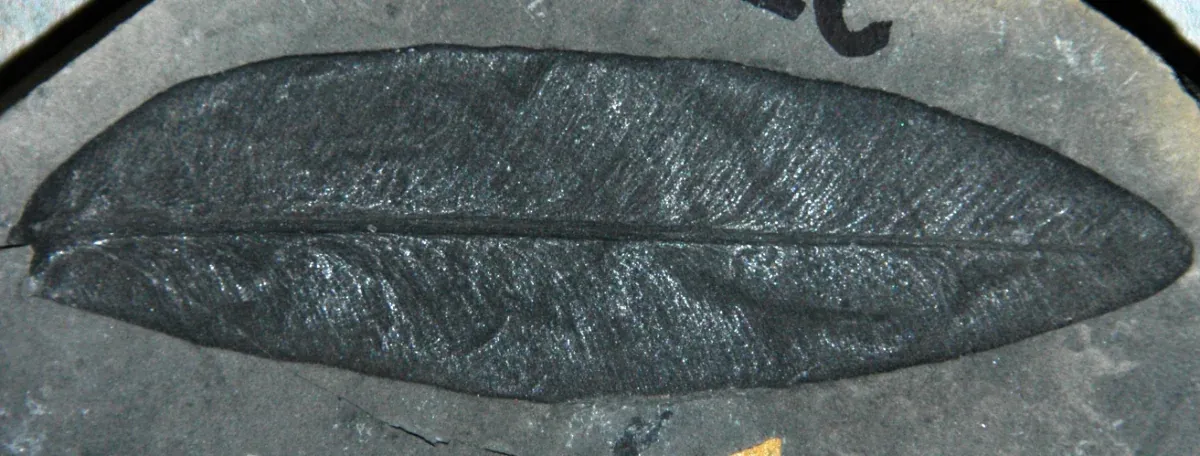

Here's the problem, and it's one of my favourite problems in the history of science, because you don't need a degree in geology to feel how wrong it is.
There is a fossil plant called Glossopteris. It's a seed fern with a distinctive tongue-shaped leaf, and it grew around 250 to 300 million years ago. You find it in South America. You find it in southern Africa. You find it in India. You find it in Australia. Same plant, same period.
Now, ordinary ferns spread by microscopic spores that can blow on the wind. But Glossopteris produced large, heavy seeds. They could not drift across thousands of miles of open ocean.
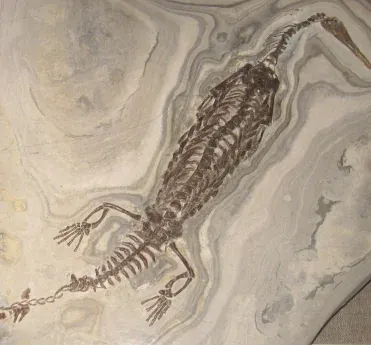

Then there's Mesosaurus. Small aquatic reptile, about a metre long, long thin snout full of needle teeth. It lived in fresh water — in lakes and lagoons. Also extinct. Its fossils are found in exactly two places on Earth: eastern Brazil, and southern Africa. Nowhere else. Ever.
An ancient freshwater reptile the size of a cat, on both sides of the South Atlantic, and nowhere else on earth.
That little creature could no more have swum across three thousand miles of deep, salty ocean water than a goldfish could cross the Pacific. And it wasn't just Mesosaurus — the entire fossil ecosystem matched. Same plants, same freshwater fish, same land reptiles, buried in matching rock layers across landmasses now separated by vast oceans.
By the late 1800s, this was no longer an anomaly you could ignore. It was documented, catalogued, and undeniable.
So what do you do?
Well, what you do depends entirely on what you already believe is physical reality. And what Suess believed — what every respectable geologist believed — was that continents are immovable anchors. They do not slide sideways across the globe. That was not up for debate.
So if the animals couldn't cross the ocean, and the continents couldn't move... then there must once have been dry land in between.
Suess proposed that colossal land bridges once spanned the ocean basins — vast continental highways along which Mesosaurus could paddle and Glossopteris could spread. And then — because those land bridges clearly aren't there today — Suess argued that as the inner Earth shrank, those land corridors collapsed, sinking into the deep ocean floors.
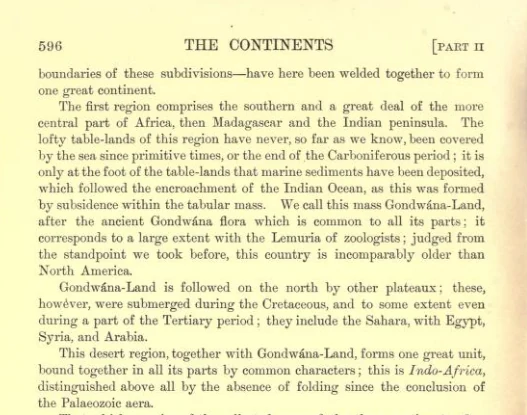
He gave this ancient, connected southern assembly a name, borrowed from the Gondwana region in central India where the fossil plants were first classified. He called it Gondwana-Land.
Eduard Suess, 18853We call this ancient continent Gondwána-Land, after the ancient Gondwána flora which is common to all its parts.
3 · VerbatimDas Antlitz der Erde / The Face of the Earth, vol. 1
And I want you to appreciate how close Suess came. He correctly deduced that the southern continents were once a single mega-continent. He's even named it — we still use his name today. Gondwana is on the maps in every geology textbook in the world.
He got the what completely right.
He just couldn't imagine the landmasses moving horizontally. So instead of sliding the continents apart, he sank the ocean floor underneath the land bridges.
§ V
The Trapdoor Problem
So by 1900, here is the grand picture geology had arrived at: a shrivelling apple with trapdoors in it.
The mountains are wrinkles from cooling. The oceans are continental blocks that dropped downwards to the interior. Continents rise and fall vertically, like sections of a stage set, but they never travel sideways.
And even at the time, some felt an uneasy scepticism — because look at what the theory was forcing you to believe. To explain Mesosaurus, you have to sink a continent-sized landmass into the Atlantic. To explain the same fossils in India and Australia, you sink another one across the Indian Ocean. Every time a palaeontologist finds a matching fossil on opposite sides of the world, geology has to invent and drown another lost continent.
That's not a theory explaining nature. That's a theory begging for credit.
There's also an arithmetic problem sitting inside contraction theory that a few physicists were starting to point out.
If you measure the actual horizontal squeezing in a mountain range — which you can do by unfolding the crumpled rock layers to see how wide they used to be — and you add that up for every mountain belt on Earth, you get a staggering number. The Alps alone require the crust to have shortened by well over a hundred miles.
Now ask how much a cooling Earth could plausibly contract, using Lord Kelvin's own figures for thermal contraction.
The maths does not work. There simply isn't enough thermal shrinkage available in the entire planet to form the mountains we have. Not even close.
For a time, the scientific consensus swept this under the rug — assuming the calculations were rough or the interior was colder than expected. But the foundation had cracked, and the crack was widening.
§ VI
The Thing Nobody Had Asked

So let's take stock, because we're about to hit the hinge of our whole story.
Around 1900, the absolute scientific consensus was: a relatively young Earth, at most a few tens of millions of years old, cooling from an original molten state, contracting as it chills, wrinkling its skin into mountains, with continents that bob up and down but never sideways, and a set of drowned land bridges invented to explain a fossil record that otherwise makes no sense.
Every part of that consensus was about to be utterly destroyed.
And underneath all of it sat a question nobody had thought to ask, because the answer was too obvious to need checking. Do the continents stay where they are?
And here's the beauty of it — it wasn't destroyed by geologists.
It was destroyed by two pieces of work carried out for reasons that had nothing whatsoever to do with mountains.
The first was a grand trigonometric survey in British-colonised India, designed purely to draw accurate military and tax maps of the subcontinent. When their weighted survey lines began behaving strangely near the Himalayas, the explanation would prove that continents are not heavy slabs that can sink into the Earth — they are light, buoyant blocks floating on denser rock underneath. You cannot sink a continent, ever, under any circumstances.
Which is a problem, if your entire fossil story depends on sinking them.
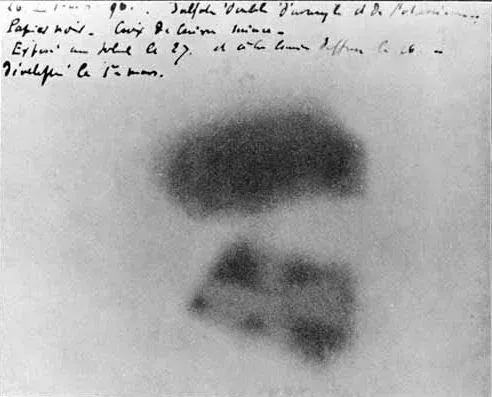
And the second breakthrough happened in a dark lab in Paris, where a French physicist left some uranium salts in a drawer with a sealed photographic plate — only to find the plate inexplicably fogged when he took it out.
That fogged plate would completely obliterate Lord Kelvin's clock. It would shatter his estimate for the age of the Earth, and destroy the assumption that the planet is simply cooling down.
Because it turns out the Earth is not an apple on a windowsill, slowly drying out.
It's a kettle that somebody left on.
Next time on The Slow Machine: two facts that cored the apple — how mountains turned out to be icebergs, and how the most certain number in nineteenth-century science was off by a factor of a hundred.
Every episode of this series has a page at theslowmachine.com — the full transcript, and a table of every quotation in it with the source it came from. If you would like to write to me, the address is michael.goddard@theslowmachine.com.
Apparatus
Quotations, and where they come from
1KelvinVerbatim"The Age of the Earth as an Abode Fitted for Life", 1897 address
2Darwin — "sorest troubles"Verbatim fragment, narrator-framed. Verified: "Thomson's views of the recent age of the world have been for some time one of my sorest troubles."Darwin to A. R. Wallace, 14 April 1869
3Suess — Gondwána-LandVerbatim, from the standard English translationDas Antlitz der Erde / The Face of the Earth, vol. 1