The Slow MachineThe Weatherman
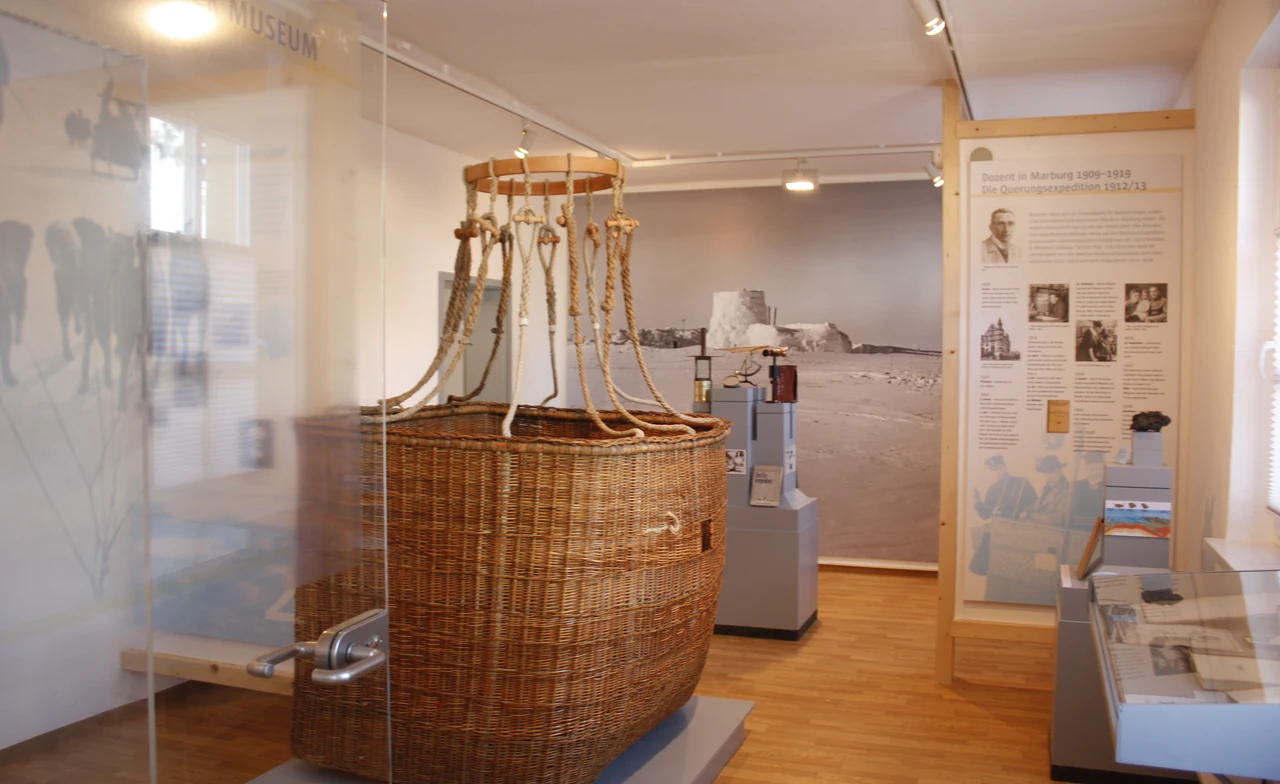
On the fifth of April, 1906, two brothers climbed into a wicker basket underneath a hydrogen balloon and cast off from a field in northern Germany.
They came down fifty-two and a half hours later. Nobody had ever stayed up that long. They had crossed into Denmark, out over the sea, back again, and they had done it, officially, to test a navigation instrument and take readings of the air.
Think about what that actually is. Two and a half days in a basket, in the cold, awake, in a medium nobody had mapped — because in 1906 the sky above about five kilometres was genuinely unknown territory. Not metaphorically. Nobody had been there and written down what it was doing.
The younger brother in that basket was twenty-five years old. His name was Alfred Wegener, and six years later he would stand up in front of the German geological establishment and tell them that the continents move.
They did not take it well.
This is The Slow Machine. Episode four: the weatherman.
§ I
A Man Who Studied a Fluid
Alfred Wegener is usually introduced as "a meteorologist" — and it is almost always delivered with the condescension you'd reserve for Albert Einstein's barber trying to correct the math on general relativity. A weatherman. Not a real scientist. Not a geologist, anyway.
So let's be accurate about who he was, because it matters enormously for what he saw.
He took his doctorate in astronomy, in Berlin, in 1905. His thesis was a piece of painstaking technical housekeeping — taking the Alfonsine Tables, a set of medieval astronomical tables, and rendering them usable by a modern calculator. It is the work of someone comfortable with old data and willing to do unglamorous arithmetic.
And then, having qualified in the oldest science there is, he walked away from it into the newest.
Meteorology in 1905 was barely a discipline. It was closer to a collection of hunches with barometers attached. What it lacked was data from the only place that mattered — up.
So Wegener went up. He and his brother Kurt worked at the Royal Prussian Aeronautical Observatory at Lindenberg, and they spent their time sending kites and tethered balloons into the sky with instruments strapped to them, hauling them back down, and reading off what the air had been doing at altitude.
This was not a stunt. This was the deliberate opening of a new laboratory, and Wegener was one of the people who understood first that the atmosphere is not weather-that-happens-to-us. It is a structure. It has layers. Those layers have different densities and temperatures, they slide over one another, they have boundaries you can locate and measure — and the whole thing is in permanent, slow, organised motion.
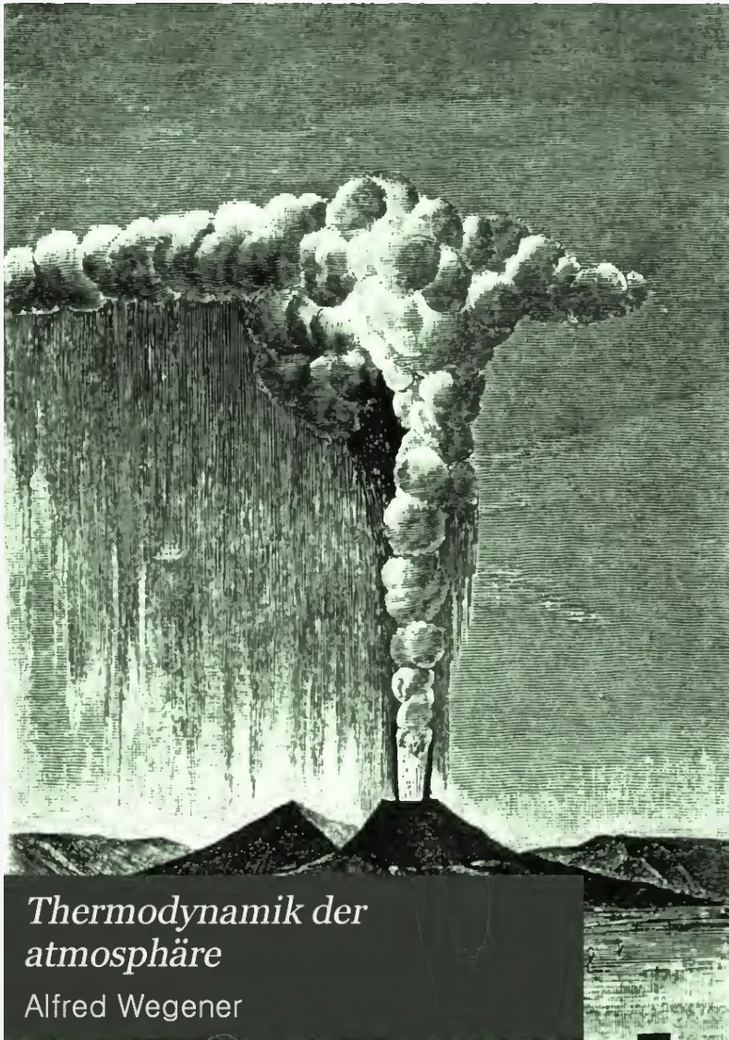
In 1911 he published a textbook called Thermodynamik der Atmosphäre — The Thermodynamics of the Atmosphere. It revolutionised meteorology from a descriptive hobby into a rigorous, mathematical branch of physics and remained the standard work for a generation.
I want to slow down here, because this is the part that usually gets skipped, and it is the reason the rest of the episode happens.
Spend your twenties studying a fluid, and you acquire a particular habit of mind.
You stop assuming that things which look static are static. You get comfortable with the idea that a medium can be rigid over a short interval and fluid over a long one. You expect material of different densities to sort itself out — light on top, heavy below, each finding its level. You expect circulation. You expect that if there is heat somewhere, something is moving somewhere else because of it.
Every geologist of the period had been trained to look at the Earth and see structure. Wegener had been trained to look at a fluid and see flow.
He was about to look at the Earth.
§ II
The Torn Newspaper
The story starts, as these things often do, with something everybody already knew.
Look at a map of the Atlantic. The bulge of South America fits the hollow of West Africa. It has been remarked on since the first halfway-accurate charts of the ocean existed — three hundred years of people noticing, and shrugging.
Because it was an armchair speculation. The kind of thing you say at dinner. A cloud looks like a horse; South America looks like it was cut out of Africa. Very well. Please pass the salt.
In late 1911, Wegener — by then teaching at Marburg — came across a scientific paper that catalogued the fossil correspondences between Brazil and Africa. The same extinct creatures, the same extinct plants, on both sides of the ocean.
And the two things collided in his head. The shapes fit. And the contents match.
Now — here is where Wegener stops being a man with a hunch and becomes a scientist with a method, and he explained it himself with an image so good that it is still the standard way of teaching this a century later.
Alfred Wegener1It is just as if we were to refit the end of the torn pieces of a newspaper by matching their edges and then check whether the lines of print run smoothly across. If they do, there is nothing left but to conclude that the pieces were in fact joined in this way.
1 · VerbatimThe Origin of Continents and Oceans, Wegener, trans. John Biram (1966), p. 77
Tear a page of newspaper in half. Hold the two halves together.
Matching the ragged edge proves very little — ragged edges are ragged, and you can talk yourself into almost any fit. That is the coastline. That is the armchair speculation, and on its own it is worthless.
The proof is in the print. If a sentence runs off the edge of one piece and continues, word for word, on the other — if the paragraphs line up, if the columns are continuous — then you are not looking at a coincidence. You are looking at one page.
So Wegener went and checked the print.
And the print ran across.
Mountain belts of a particular age and character run down into the sea in Argentina, and pick up again on the other side, in South Africa. Distinctive sequences of rock in Brazil match sequences in Africa bed for bed — this layer, then that layer, then that one, in the same order, on both sides of three thousand miles of salt water.
Ancient coal seams sit in Britain and Nova Scotia. Coal is compressed swamp. It is the residue of hot, wet, rotting forest, and it does not form where Britain is.
Every one of those is a line of print running across the tear.
§ III
His Father-In-Law's Filing System
Now we come to the part of this story I like best, because the whole argument of this series happens inside one family.
In 1913, Wegener married a woman named Else Köppen. Her father was Wladimir Köppen — one of the most eminent climatologists alive, and the author of something you have almost certainly seen without knowing whose it was.
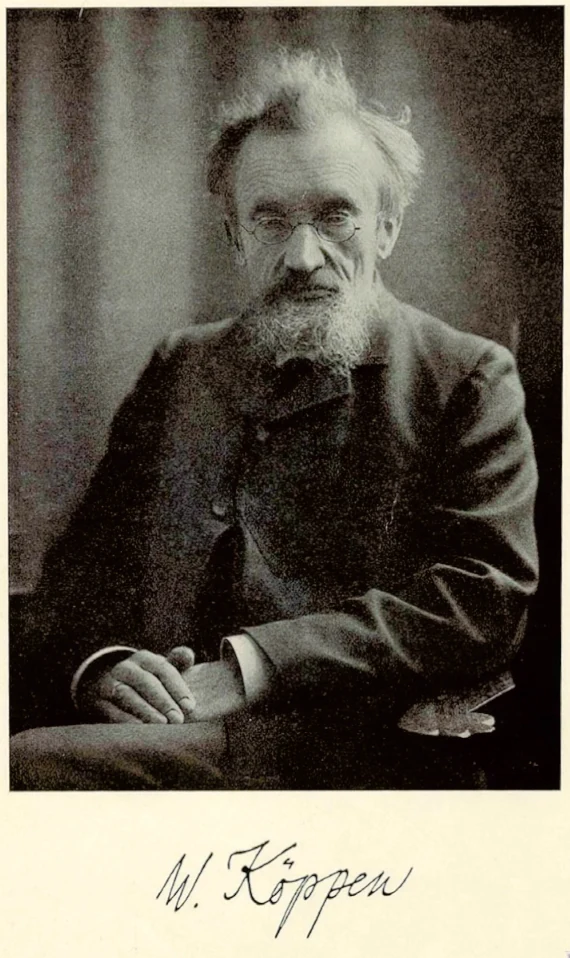

Köppen had spent decades on a problem that sounds dull and isn't: how do you classify climate? Not describe it — classify it. Sort every place on Earth into a finite set of boxes, in a way that actually means something.
His solution was to stop asking what the weather felt like and start asking what it grew. Take temperature. Take rainfall. Take how those two are distributed across the year. Cross-reference them, and the boxes that fall out of the matrix turn out to match the vegetation on the ground with uncanny precision. Tropical rainforest. Desert. Steppe. Temperate. Polar ice.
It is a filing system for the surface of the planet, and it is still in use today. If you have ever seen a world map coloured in bands — green through the middle, sandy stripes either side of it, white at the poles — you have seen Köppen's matrix.
I saw one of those maps in the atlas I grew up with. I must have looked at it a hundred times, and I never once wondered whose it was, or what it had cost somebody to work out.
He built it to explain the world as it is.
Wegener took his father-in-law's filing system and pointed it at the past.
Here is what he did, and it is genuinely lovely. He worked out that certain rocks are climate fossils. They can only form under particular conditions, and those conditions are Köppen categories.
Coal means hot and wet — swamp, rainforest, the equatorial band.
Thick beds of salt and gypsum mean standing water evaporating faster than it is replaced. So does a particular kind of wind-blown desert sandstone. Those mean the arid belt — the band of dry that sits roughly thirty degrees north and south, where the great deserts are now.
And then there is tillite. Tillite is the rubble a glacier leaves behind, jammed together and turned to stone: a chaotic mess of boulders and grit with no sorting to it, because ice does not sort what it carries. Underneath it, very often, you find the bedrock the ice ground across — polished smooth, and scratched with long parallel grooves in the direction the ice was travelling.
Tillite means an ice sheet. There is no other way to make it.
So now you can do something that had never been done.
Go through the rock record. Every time you find a climate fossil, tag it with its Köppen zone — tropical, arid, temperate, polar. Then plot every tag on a map of the world as it is today, for one slice of geological time.
Köppen and Wegener did exactly this, and published it in 1924 as Die Klimate der geologischen Vorzeit — The Climates of the Geological Past. It contains the first global maps of ancient climate ever drawn.
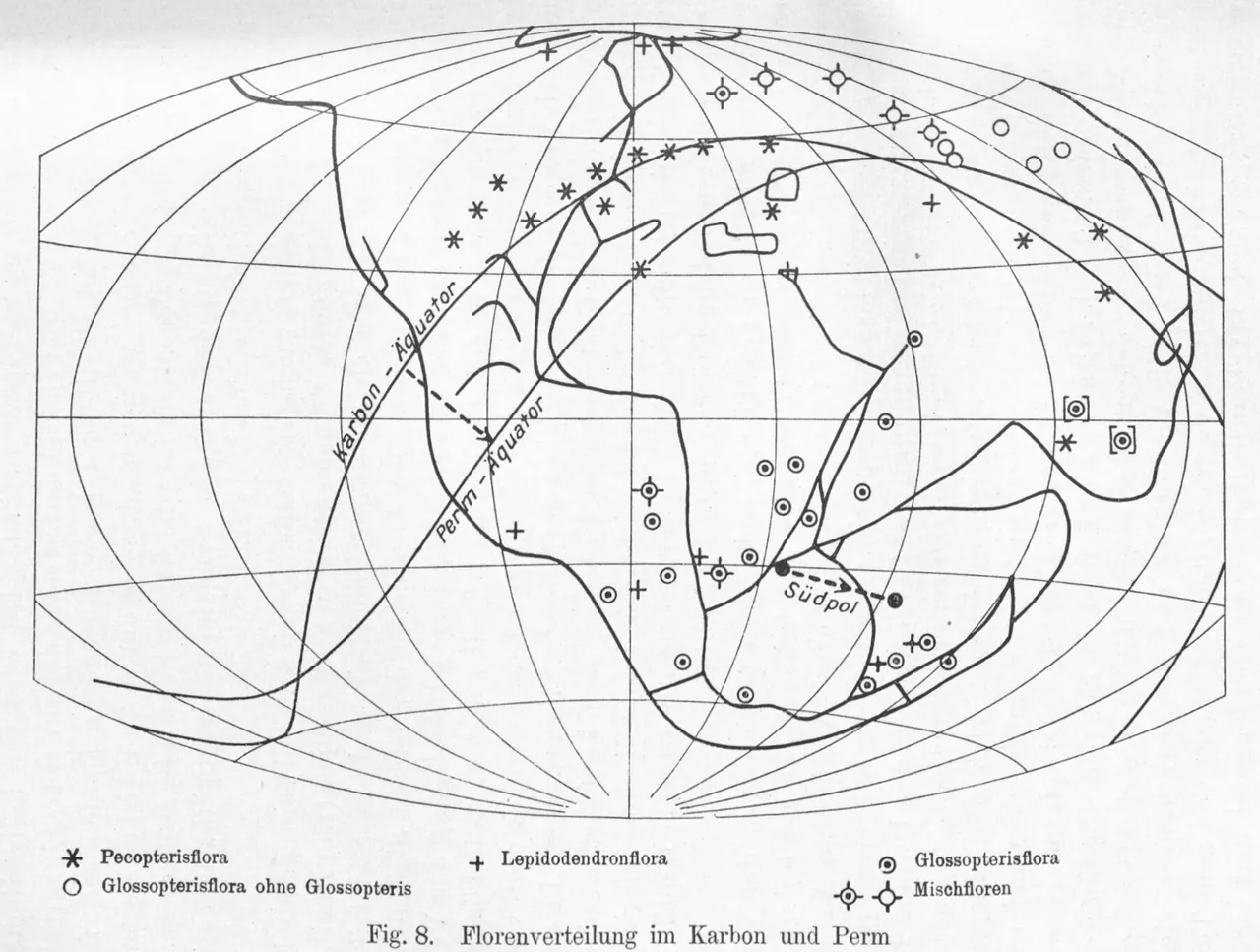

And when you plot the tags on a modern map, what you get is nonsense.
The zones don't form bands. They form a scatter. You have polar ice deposits sitting in India, which is tropical. You have coal — hot, wet, equatorial coal — in Spitsbergen, inside the Arctic Circle. You have desert sandstone at latitudes that could never have been desert. The pattern isn't a pattern. It's a spill.
And then you slide the continents.
§ IV
Ice in the Tropics
Let me take the single strongest case on its own, because it does not need any of the rest.
Between roughly three hundred and two hundred and sixty million years ago — the late Carboniferous into the Permian — there was a very large ice age. We know this the way we know about any ice age: from the tillite, and from the scratches underneath it.
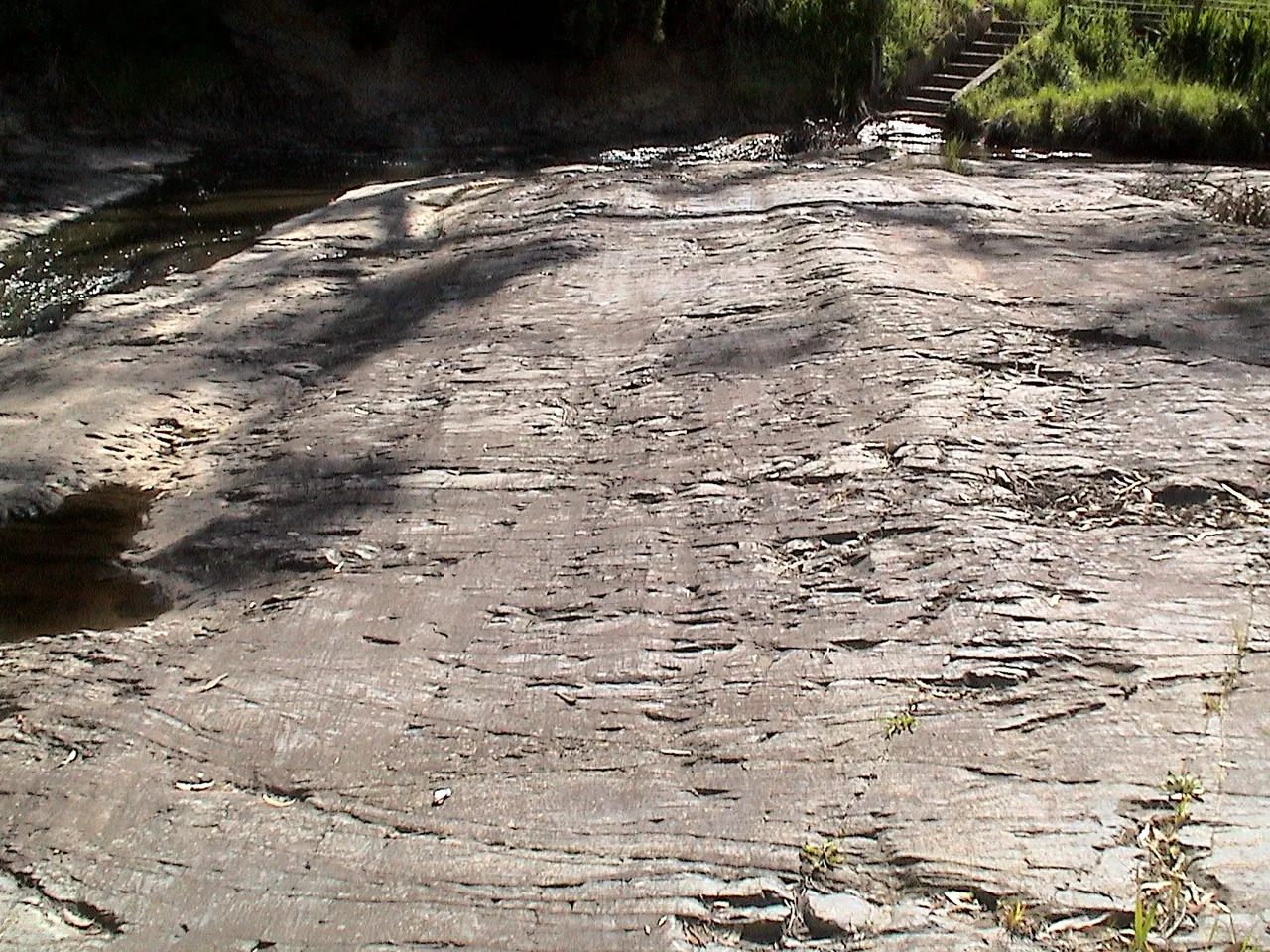

Here is where the evidence is. Southern Africa. India. Australia. South America. Fragments in Antarctica.
Same period. Same rubble. Same grooves gouged into the rock beneath.
Now lay that on a globe as the globe is now, and look at what it asks you to believe.
You need an ice age that covered central India, southern Australia, southern Africa and Brazil — most of which sit in or near the tropics — while leaving Europe and North America, which are much nearer the pole, temperate enough to grow coal swamps at the same moment.
That is an ice age that froze the equator and spared the poles.
You cannot do that. There is no adjustment to the Sun, no wobble in the orbit, no atmospheric change that produces ice in Madras and rainforest in Greenland simultaneously. The Earth simply does not have a mechanism for it.
So for as long as the continents are nailed down, this evidence isn't evidence. It's an embarrassment — something in the literature that everybody works around.
Now slide them.
Take South America, Africa, India, Australia and Antarctica and push them together into one mass — the same mass Eduard Suess had already named Gondwana, back in Episode 2 — and park it over the South Pole.
Everything resolves at once.
The scattered ice deposits stop being scattered. They become a single ice sheet of entirely ordinary size, sitting where an ice sheet belongs — on top of the pole.
The scratches stop being random. Trace the directions they point, and they radiate outward from a common centre, exactly the way ice flows off the top of an ice cap. India's grooves and Africa's grooves and Australia's grooves all turn out to be pointing away from the same place.
The coal swamps of Europe and North America are now sitting on the equator, which is precisely where you would like your rainforest to be.
And the arid belts — the salt, the gypsum, the desert sandstone — fall into two bands either side of that equator, at about thirty degrees, exactly where the dry belts are on the Earth today.
Every anomaly becomes an ordinary feature of a perfectly normal climate system. You don't have to invent a single new process. You just have to put the land somewhere else.
That is what Köppen's filing system did when Wegener turned it around and pointed it backwards. It was built to sort the world as it is. Used on the world as it was, it located a lost South Pole.
An instrument made for one job, doing another.
§ V
All-Earth
Wegener went public on the sixth of January, 1912, in a lecture to the Geological Association at the Senckenberg Museum in Frankfurt. He expanded it into a book in 1915 — The Origin of Continents and Oceans — and kept revising it for the rest of his life.
The picture he drew was this. The continents were once assembled into a single landmass. It broke up. The pieces have been moving apart ever since, and they are still moving.
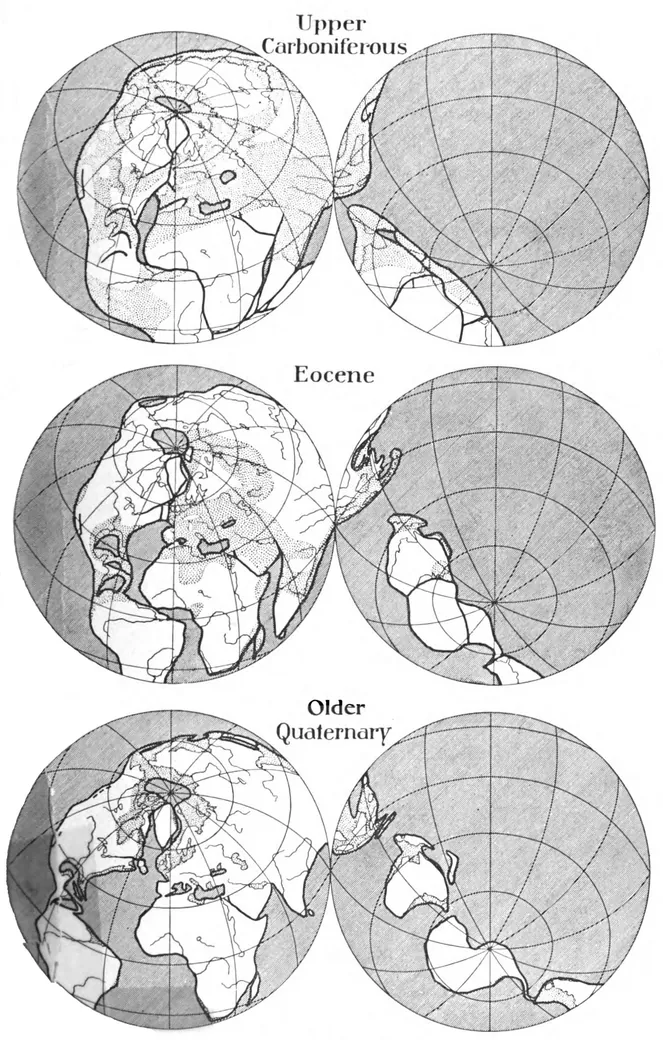

In the later editions he gave that ancestral supercontinent a name, from the Greek: Pangaea. All-Earth.
And the idea itself had a name: continental drift.
In the broad strokes, he was right.
He was right that the continents were once joined. Right about roughly which piece went where. Right that the Atlantic is not a gap something fled across but a space that opened. Right that the process is still running.
He was so nearly completely right that it is genuinely painful to describe what happened next.
§ VI
Why He Lost
It would be very easy to tell this as a story about small men shouting down a visionary. There is some of that in it — there always is.
But it is not the true story, and I want to be careful, because the real reason Wegener lost is the most important lesson in this entire series.
He could say that the continents moved. He could not say what moved them.
He tried. He proposed two forces.
The first he called Polflucht — "pole-fleeing". The Earth bulges very slightly at the equator, and Wegener argued that this produced a faint force tending to push landmasses away from the poles. The second was tidal: the pull of the Moon and Sun, dragging the continents slowly westward.
Both of these are real forces. Neither of them is nothing.
And then a British geophysicist named Harold Jeffreys — who was very good at precisely this kind of arithmetic — took Wegener's two forces and worked out how strong they actually are.
They were not merely too small. They were too small by a factor of millions. Wegener was proposing to move a continent with something closer to the force of a strong opinion.
And Jeffreys had a second objection, which was worse, and which was correct.
The rock beneath a continent behaves, to every test anyone could apply, like a solid. Not a fluid. Not a soft solid. A strong one — stronger, in fact, than the continental rock sitting on top of it.
So what Wegener was asking for was a granite ship ploughing through a steel sea. The ship disintegrates. It isn't a close call; it's not physically available.
That objection was fatal. And it deserved to be.
Because here is the thing that this series keeps returning to: being right about the what while wrong about the why is a genuinely bad position to be in. Not a moral failing — a practical one. Without a mechanism, you have no way of telling whether you have found a truth or an extremely persuasive coincidence. The fossils and the ice scratches were real evidence. But evidence is not yet knowledge, and Wegener was asking an entire discipline to throw out its foundations in exchange for a force that demonstrably could not do the job.
His critics were not being stupid. They were doing science.
§ VII
New York, 1926
In November 1926, the American Association of Petroleum Geologists convened a symposium in New York City for the specific purpose of examining continental drift.
It was less an examination than a firing squad. Speaker after speaker took the theory apart — and, in fairness, several of them took apart things Wegener had genuinely got wrong: he had been careless with some of his geology, and he badly overestimated how fast the continents move.
But the tone went further than the argument. Rollin T. Chamberlin, of the University of Chicago, delivered the line that stuck.
Rollin T. Chamberlin, 19262Wegener's hypothesis in general is of the foot-loose type, in that it takes considerable liberty with our globe, and is less bound by restrictions or tied down by awkward, ugly facts than most of its rival theories.
2 · VerbatimR. T. Chamberlin, in Theory of Continental Drift: A Symposium, AAPG, 1928, from the November 1926 New York symposium
Chamberlin also observed that if Wegener were right, geology would have to forget everything it had learned in seventy years and begin again.3
3 · ParaphrasedChamberlin — "forget everything learned in the last 70 years"Same symposium volume
He meant it as a reason to reject the theory. He was, of course, describing precisely what was going to happen.
The verdict held. In the English-speaking world, and especially in North America, continental drift became the sort of thing that could end a young scientist's career if they were caught taking it seriously. Not wrong — unserious. Which is worse.
And underneath the scientific objection sat a second one, quieter and less respectable. Wegener was not a geologist. He was an outsider, from a soft new field, with a doctorate in the wrong subject, telling the professionals that their foundations were rubble.
An age of specialists had very little idea what to do with a man who refused to specialise.
§ VIII
The Ice
Wegener went back to Greenland.
He had been there twice already — first in 1906, as the expedition meteorologist on a Danish expedition to the north-east coast, where he became the first person to fly kites and balloons over the Arctic ice; then in 1912, crossing the inland ice on foot, the longest such crossing anyone had made.
In 1930 he led his own expedition. The plan was serious science: three stations on a line across Greenland, taking continuous measurements through the winter, including the first attempt to sound the thickness of the ice sheet itself. He wanted a winter's worth of weather from the middle of the ice, and a real figure for how deep it goes — because nobody knew whether the ice sheet was hundreds of metres thick or thousands.
The middle station was called Eismitte — "mid-ice". Two men were wintering there, four hundred kilometres in from the coast, and by the autumn it was clear they did not have enough supplies to survive until spring.
So Wegener took a dog-sledge party inland to reach them.
He got there. It took forty days through worsening weather, and most of the party turned back, but he got there.
There were not enough supplies at Eismitte for the men already there plus the men who had just arrived. So on the first of November, 1930 — his fiftieth birthday — Wegener set out for the coast again with a single companion, a young Greenlandic man named Rasmus Villumsen.
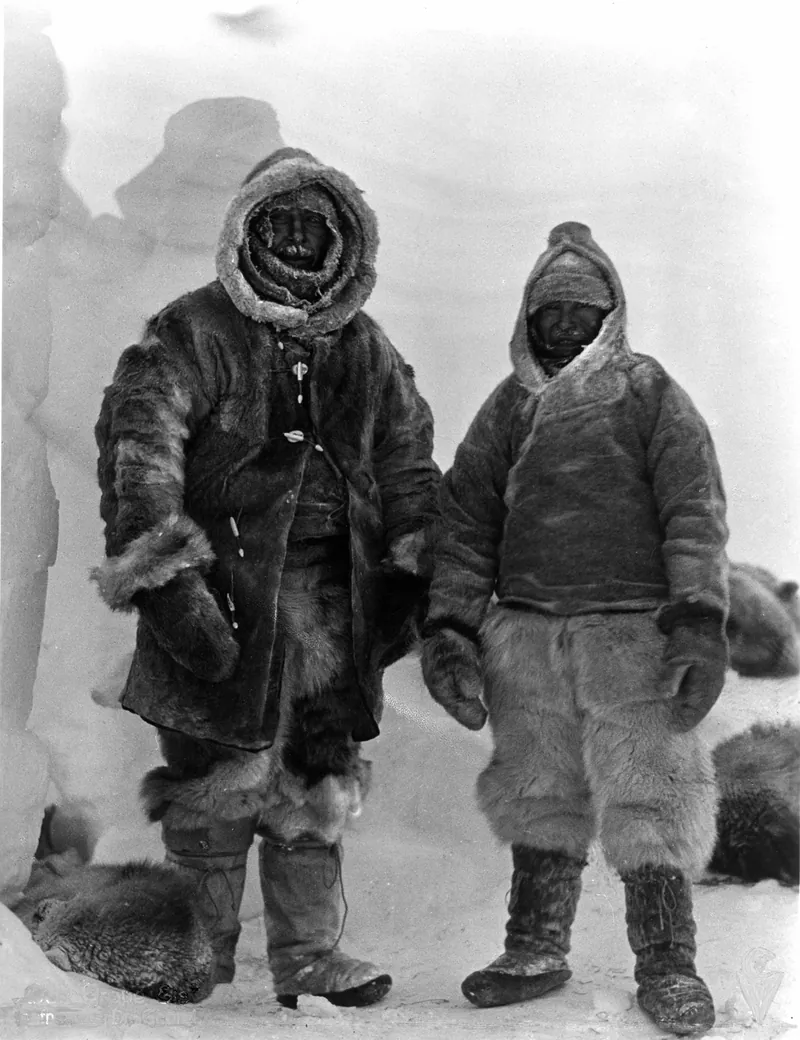
They did not arrive.
Wegener died somewhere out on the ice, probably within a fortnight, most likely of heart failure from sheer exertion. Villumsen buried him, and went on alone, and was never found.
On the twelfth of May, 1931, a search party crossing the ice sheet saw something standing upright in the snow.
It was a pair of skis, planted deliberately as a marker.
They dug. About a metre down they found Wegener, sewn carefully into his sleeping bag and covered with a fur coat, laid out with real attention by someone who had then walked away to die himself.
Wegener was left where he was. There is no better place to put him.
So that is the position, forty years into this story.
There is a mass of evidence that the continents were once joined, assembled by a man using his father-in-law's weather charts and a torn newspaper. And there is a fatal objection. A continent is not a raft floating on water. It is rock, all the way down, sitting in more rock — and nothing known to physics can push one through the other.
And there is a room full of geologists who have quite reasonably concluded that the objection wins.
What nobody in that room has is any idea what the inside of the Earth is actually like. Not the crust — the rest of it. The other ninety-nine per cent. Nobody has seen it, nobody can dig to it, and nobody has the faintest idea what it is doing down there.
Which is where the next instrument comes in — and this one was built to record disasters.
Next time on The Slow Machine: listening to the inside. What an earthquake tells you if you know how to hear it, why the answer to Wegener's problem was that everybody was asking the wrong question about the mantle — and an English geologist who worked out how the engine works, said so in print, and admitted he could not prove a word of it.
Every episode of this series has a page at theslowmachine.com — the full transcript, and a table of every quotation in it with the source it came from. If you would like to write to me, the address is michael.goddard@theslowmachine.com.
Apparatus
Quotations, and where they come from
1Wegener — "It is just as if we were to refit the end of the torn pieces of a newspaper..."Verbatim, verified against the printed page by eye, 2026-09-25. Michael's copy: Biram translation of the 4th edition, 1966, ch. 5 "Geological Arguments", p. 77. Quoted exactly as printed, including "the end of" and the absence of a comma before "and then check"The Origin of Continents and Oceans, Wegener, trans. John Biram (1966), p. 77
2Chamberlin — "foot-loose type"VerbatimR. T. Chamberlin, in Theory of Continental Drift: A Symposium, AAPG, 1928, from the November 1926 New York symposium
3Chamberlin — "forget everything learned in the last 70 years"Paraphrased on air — narrator says "also observed that", does not present as a quoteSame symposium volume
—Köppen — no guest read—Köppen appears descriptively only; no quotation is attributed to him