The Slow MachineListening to the Inside
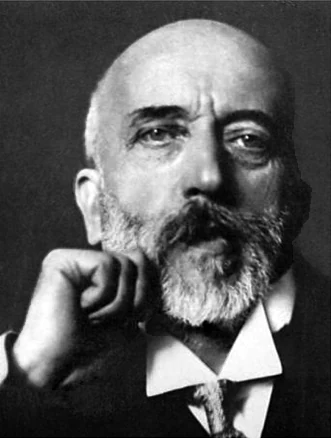

On the eighth of October, 1909, the ground shook in the Kupa Valley, about forty kilometres south-east of Zagreb, in what is now Croatia.
It was a serious earthquake but not a famous one. Houses came down. It has no particular place in history, except for the people who lived there.
What matters is what happened in the months afterwards, in an office in Zagreb, where a man sat down with the paper traces from a scatter of recording stations and noticed something that should not have been there.
The waves had arrived twice.
Not an echo. Not an aftershock. At stations a certain distance away, the same shock registered as two separate arrivals, a measurable interval apart — as though the earthquake had taken two different routes to get there, and one of them was quicker.
The man was named Andrija Mohorovičić, and he worked out what it meant, which was this. Some of the energy had travelled straight through the shallow rock. The rest had gone down, hit something about fifty kilometres beneath his feet, sped up sharply, run along under it, and come back to the surface ahead of the first lot.
There was a boundary down there. A floor. And nobody had ever suspected it.
Now, here is a detail I enjoy more than I should. Andrija Mohorovičić was, by training and profession, a meteorologist. He ran the meteorological observatory in Zagreb. The paper announcing the bottom of the Earth's crust was published in the yearbook of a weather institute.
Last episode, a meteorologist told the geologists their continents move, and was thrown out of the room. This episode, a meteorologist finds the floor of the world, and nobody even notices where the paper came from.
Nobody has ever been more than a few kilometres into the Earth. Not then. Not now.
And yet within thirty years of that afternoon in Zagreb, we had the inside of this planet mapped — its layers, their depths, which of them are solid and which are liquid — in a level of detail that has barely changed since.
We did it by listening.
This is The Slow Machine. Episode five: listening to the inside.
§ I
The Struck Bell
Start with the instrument, because as usual the instrument was built for something else.
In 1880, in Tokyo, an English mining engineer named John Milne built a machine to record earthquakes. Japan gave him plenty of material to work with. His design — a weight on a horizontal pendulum, so heavy and so delicately suspended that when the ground moved the weight effectively didn't, and a pen scratched the difference onto a turning drum — was the first seismograph that was both sensitive enough to be useful and simple enough to be copied.
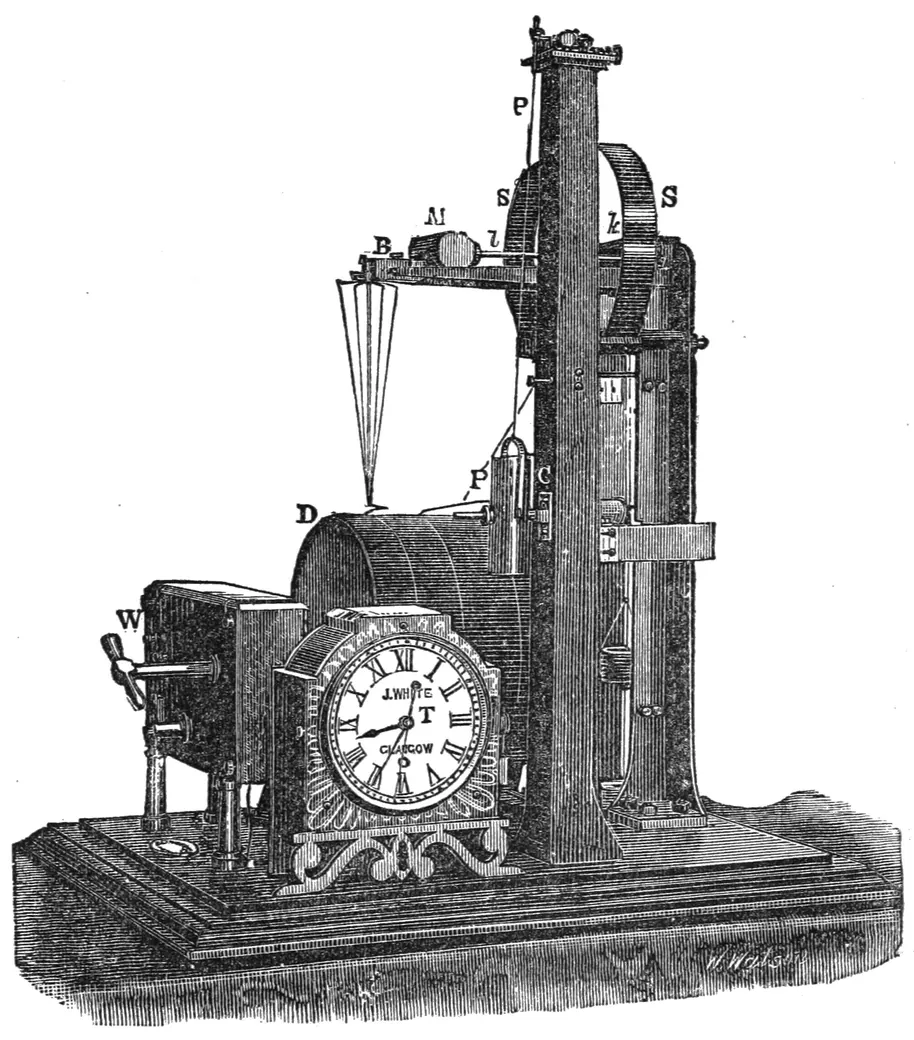

And then Milne did the thing that actually mattered. He talked the Royal Society into paying for a network. By the early 1900s there were about thirty near-identical Milne seismographs scattered around the world, mostly in coastal cities at middling latitudes, all making the same kind of trace.
The purpose was disaster. Earthquakes kill people; a serious country records them; and if you have a network you can locate a quake rather than merely feel it.
That was the brief. Record the catastrophe, and isolate where it happened.
What they had actually built was an X-ray machine for the planet, and it took a while for anyone to notice.
Here is the principle.
Hit a bell with a hammer, and the bell rings. The sound that comes out is not really about the hammer. It's about the bell — its size, its shape, its thickness, whether there's a crack in it. A keen ear can tell you an enormous amount about a bell it has never seen, purely from how it answers a blow.
An earthquake is a hammer blow, and the Earth is the bell.
The energy spreads out through the whole body of the planet, not just around the surface, and it arrives somewhere else having passed through everything in between — and it arrives changed, in ways that depend entirely on what it went through.
Every seismograph on Milne's network was a microphone pressed against the Earth. You don't need to dig. You need enough earthquakes, enough stations, and enough patience to read what comes out.
§ II
Two Kinds of Shaking
There are two ways to send a wave along something, and you have likely done both.
Take a long spring — a Slinky — and stretch it across the floor. Now shove your end sharply forward. A pulse of compression runs down the coil: squeezed, then loose, squeezed, then loose. The spring moves back and forth along the same direction the wave is travelling in.
Now do it differently. Take a rope, hold one end, and flick your wrist sideways. A hump travels down the rope, but the rope itself is moving across the direction of travel.
Push-pull, and side-to-side. Both of those happen in rock, and both of them come out of an earthquake.
The push-pull wave is faster, so it always arrives first. Seismologists, with a certain lack of poetry, call it the primary wave — the P-wave. The side-to-side one comes second. You guessed it, the secondary or S-wave.
And now the single most useful fact in this entire field.
To carry a side-to-side wave, a material has to resist being twisted. Flick a rope and it works because the rope holds together sideways. Try to flick a stream of water the same way and nothing happens — the water simply slides past itself. It has no sideways stiffness at all.
So: S-waves cannot travel through a liquid. Not slowly. Not at all.
P-waves will go through anything — solid, liquid, gas. Sound in air is a P-wave.
Which gives you a test you can run on material a thousand miles beneath your feet, without going there. If both kinds of wave arrive, whatever they crossed was solid. If the push-pull arrives and the side-to-side never does, something down there is liquid.
There is a second trick, too. Waves change speed when the material they are travelling through changes, and a wave that changes speed bends — the same reason a straw looks broken in a glass of water. So every boundary inside the Earth leaves a signature: waves bending, waves reflecting, waves arriving early or late or not at all.
Read enough of those signatures and you can draw the inside of the planet.
§ III
What Was Down There
So here is what came out, over about thirty years, from a network built to record disasters.
Mohorovičić, 1909. The crust has a bottom — that boundary in the Kupa Valley traces, around fifty kilometres down beneath a continent, and much shallower under the oceans. Below it, the rock is different: denser, faster. It is still called the Mohorovičić discontinuity, and nobody says that twice, so everybody says the Moho.
This is worth focusing on. Everything humans have ever done, every mine, every city, every mountain range, sits on the skin of the earth. Proportionally it is thinner than the skin on an apple.
Richard Dixon Oldham, 1906 — three years earlier, in fact. Oldham was working on Indian earthquake records, and he found that stations far around the curve of the Earth from a quake were not recording the waves they should have. There was a region on the far side where the expected waves simply failed to appear.
Something big and different sat in the middle of the planet, blocking them. That was Oldham's conclusion, and it was right. The Earth has a core.
Beno Gutenberg, 1913. Gutenberg nailed it down. He put the top of that core at about two thousand nine hundred kilometres deep — a figure that has survived a century of refinement essentially intact — and he read the pattern of missing arrivals correctly. S-waves reach the core and stop.
The outer core is liquid.
Two thousand nine hundred kilometres down, this planet is molten metal — a ball of liquid iron very nearly the size of Mars.
Inge Lehmann, 1936. A Danish seismologist working through stacks of earthquake records — famously filed in old oatmeal cartons — found faint P-wave arrivals in places that ought to have been dead quiet. The only thing that explained them was another boundary, deeper still: a solid inner core, sitting inside the liquid one like a seed in a mango.
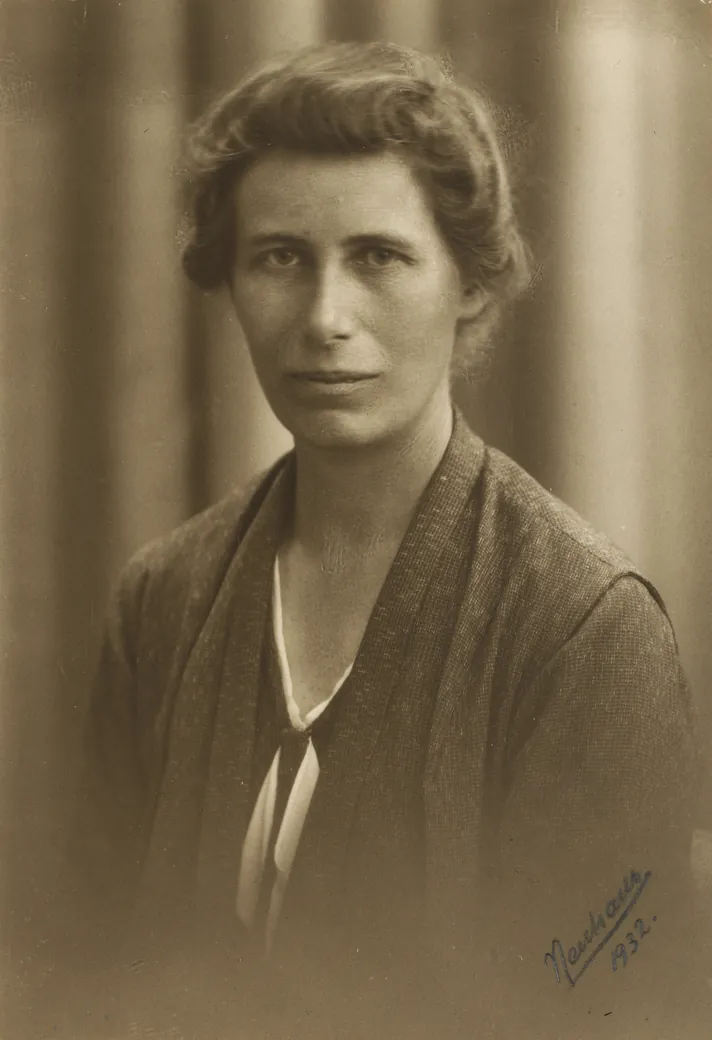

Reflect for a moment about this. By 1936 we knew the Earth had a thin crust, a thick middle, a liquid outer core and a solid inner core, and we knew how deep each boundary sat — and the deepest hole anyone had ever dug was a mere scratch. That work is one of the great pieces of indirect reasoning in the history of science, and it was done with instruments installed to count disasters.
§ IV
Which Appears to Finish Wegener Off
Now. The part of that list that is key to our story is the part I have not emphasised, so let me say it plainly.
Between the bottom of the crust and the top of the core there are two thousand nine hundred kilometres of rock. That is the mantle, and it is the overwhelming bulk of this planet — the crust and the core together are the peel and the seed.
And S-waves go through it. All of it. Every one of those two thousand nine hundred kilometres.
The mantle is solid.
Remember where we left Alfred Wegener. Dead on the Greenland ice, his theory demolished, and demolished for a reason that was legitimate: Harold Jeffreys had shown that you cannot drag a continent through the material underneath it, because that material behaves like a strong solid. A granite ship cannot plough a steel sea.
In 1924, when Jeffreys published that objection, it was an argument from the behaviour of rock in a laboratory.
By the 1930s Jeffreys's objection was not an argument any more. It was a measurement, taken through the whole thickness of the planet, by instruments with no opinion about continental drift whatsoever.
The mantle is solid. Continental drift is not merely unexplained. It now looks actively refuted — and refuted by the newest, hardest, most physical evidence available.
That is where the argument sits. And that is the moment to introduce two men who were not having it.
§ V
The Man Who Walked the Evidence
The first was a South African named Alexander du Toit, and his case rests on something that is not about cleverness at all. It is about where you were standing.
Du Toit was born in 1878 near Cape Town. He went to Glasgow to study mining engineering, stayed on to lecture, and then — and this is the decisive move of his life — came home. In 1903 he joined the Geological Commission of the Cape of Good Hope.
That is not a university chair. There was no comfortable department, no endowed professorship, no assistants. It was a government mapping job, and the job was to go out and find out what the rocks of southern Africa actually consisted of, and in what order they lay.
So that is what he did, for decades. Tens of thousands of square miles of the Karoo and beyond, surveyed on foot, on horseback, and on a bicycle.
His tools were the traditional ones and they were not much. A plane table and alidade for sighting and sketching a map in the field. A Brunton pocket transit — a compass, a clinometer and a sighting mirror in a brass case that fits in your palm — for taking the angle and direction of a tilted bed of rock. A hammer. A hand lens on a string.
And one thing that was not traditional at all: a large-format field camera.
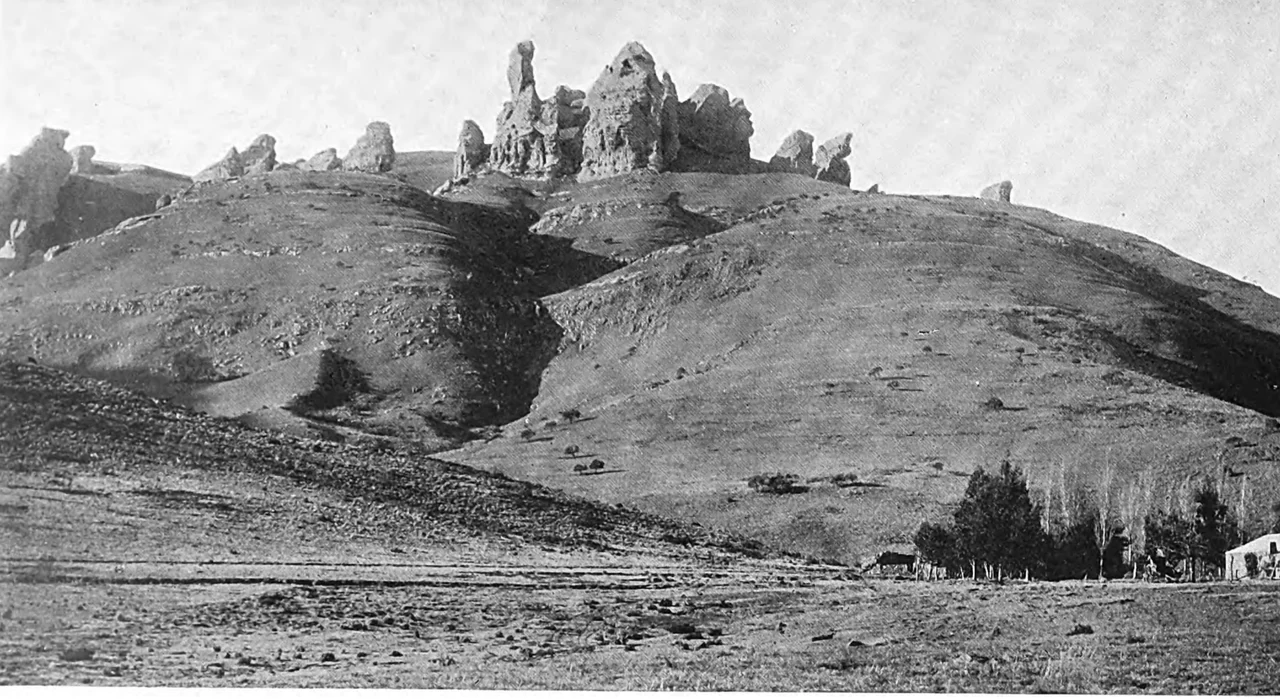
Du Toit photographed as he went. Landscapes, cliff faces, the structure of outcrops — hundreds of plates, hauled around the veld along with everything else, on a bicycle.
Remember that. It becomes important.
In 1923 he got a grant from the Carnegie Institution in Washington D.C. and spent three months in South America, doing reconnaissance mapping in Brazil, Uruguay and Argentina.
He was frugal about it in a way that tells you exactly who he was. He walked where he had to and used the railways where he could, including the Transandine line, which carried him through mountain passes that would otherwise have eaten weeks of his three months.
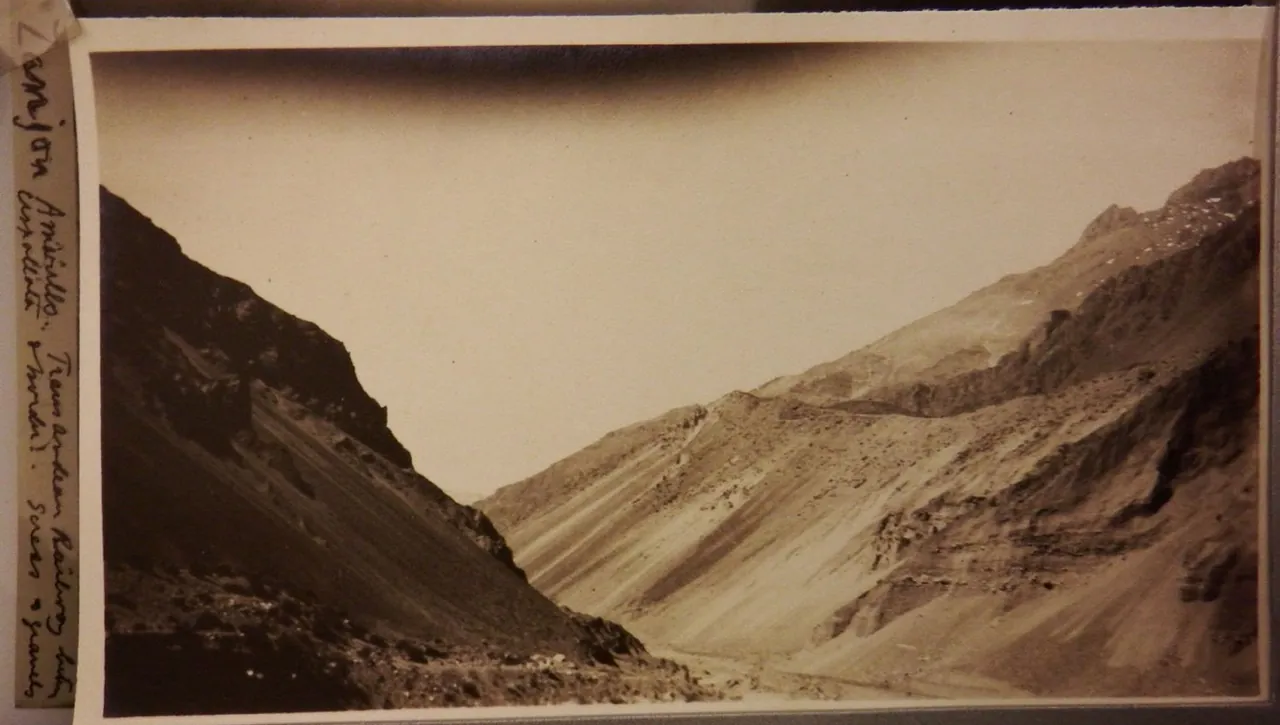
And his purpose was precise. He had spent twenty years learning the rocks of southern Africa in detail no one else possessed. Now he was going to stand on the other side of the Atlantic and see whether they were the same rocks.
They were.
This is the thing the northern hemisphere could not get its head round, and du Toit said it as directly as he could: the correspondences between southern Africa and eastern South America are not family resemblances. They are not "broadly similar formations". They are the same sequences — this bed, then this one, then this one, with the same thicknesses and the same fossils and the same intrusions cutting through them in the same places.
He published the comparison in 1927, and expanded it into a book in 1937 — Our Wandering Continents — which he dedicated to the memory of Alfred Wegener. He also improved on Wegener, splitting the original landmass into two: Gondwana in the south, and a northern mass he named Laurasia, with an ocean between them.
And here is where the camera earns its place. When du Toit put his correlations in front of sceptical audiences in Europe and North America, he was not only reading out a table of formations. He could show them the photographs. This cliff, and that cliff. Look.
You can argue with a correlation in a table. It is a good deal harder to argue with two pictures of the same rock taken four thousand miles apart.
Which gets to the real asymmetry of this whole argument, and it is not about intelligence.
The geologists rejecting continental drift were, overwhelmingly, in Britain and North America — where the evidence for it is thin, ambiguous, and a very long way away. They were arguing from maps and from other people's publications.
Du Toit was arguing from outcrops. He had put his hands on both sides.
It did not win the argument. Because du Toit, for all his thousands of miles, still could not say what moved them either. He had made the what very much harder to deny. The why was still missing.
The man who found it was sitting in Durham, England, thinking about heat and perhaps a cup of tea.
§ VI
The Cosmic Clock
Arthur Holmes was born in 1890 in the north-east of England, and he arrived at Imperial College London at the single best possible moment — just as physics was working out what radioactivity actually was.
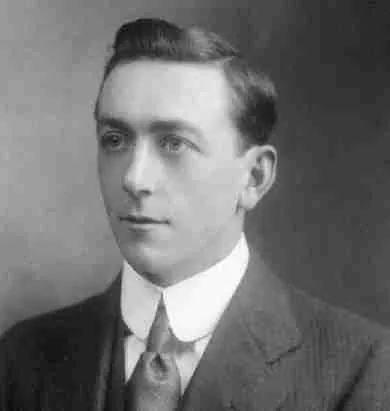

He went past very fast at the end of Episode 3, as a name attached to a number. He is about to become the most important person in this series that almost nobody has heard of.
You will remember from Episode 3 what radioactivity did to Lord Kelvin. It destroyed his clock. The Earth had its own heat source, so the cooling calculation was worthless, and the twenty-million-year Earth evaporated.
But radioactivity did not only break a clock. It handed over a better one, and Holmes saw it before almost anybody.
The logic is both beautiful and simple. A radioactive element decays into another element at a rate that is fixed. Not approximately fixed — fixed. You cannot speed it up or slow it down by heating it, squeezing it, or dissolving it in anything. Uranium turns into lead at a rate the universe does not negotiate.
So take a mineral that contained uranium and no lead when it formed. Measure how much uranium is left and how much lead has accumulated. The ratio tells you how long the mineral has been sitting there.
The rock is its own clock, and it started itself.
Holmes did this as a student. In 1911, barely out of his undergraduate degree, he published the first proper uranium-lead date of a rock — a piece of Devonian stone from Norway, which came out at three hundred and seventy million years old.
Three hundred and seventy million. Kelvin's entire Earth had been twenty to forty million.
Holmes was twenty-one years old, and the geological establishment was not delighted. He spent the next three decades being substantially more right than his seniors and being treated accordingly.
And then, as usual in this series, the numbers got good because somebody else built an instrument for an unrelated reason.
At the Cavendish Laboratory in Cambridge, a physicist named Francis Aston had been chasing a problem in pure physics: the discovery that a single chemical element can come in several versions, identical in chemistry but different in weight. Isotopes.
To study them he built a machine that could sort atoms by mass — accelerate them, bend them through a magnetic field, and let the heavier ones swing wide of the lighter ones, so that what went in as a mixture came out as separated streams you could measure. He called it a mass spectrograph. It got him a Nobel Prize in 1922 and it found more than two hundred naturally occurring isotopes.
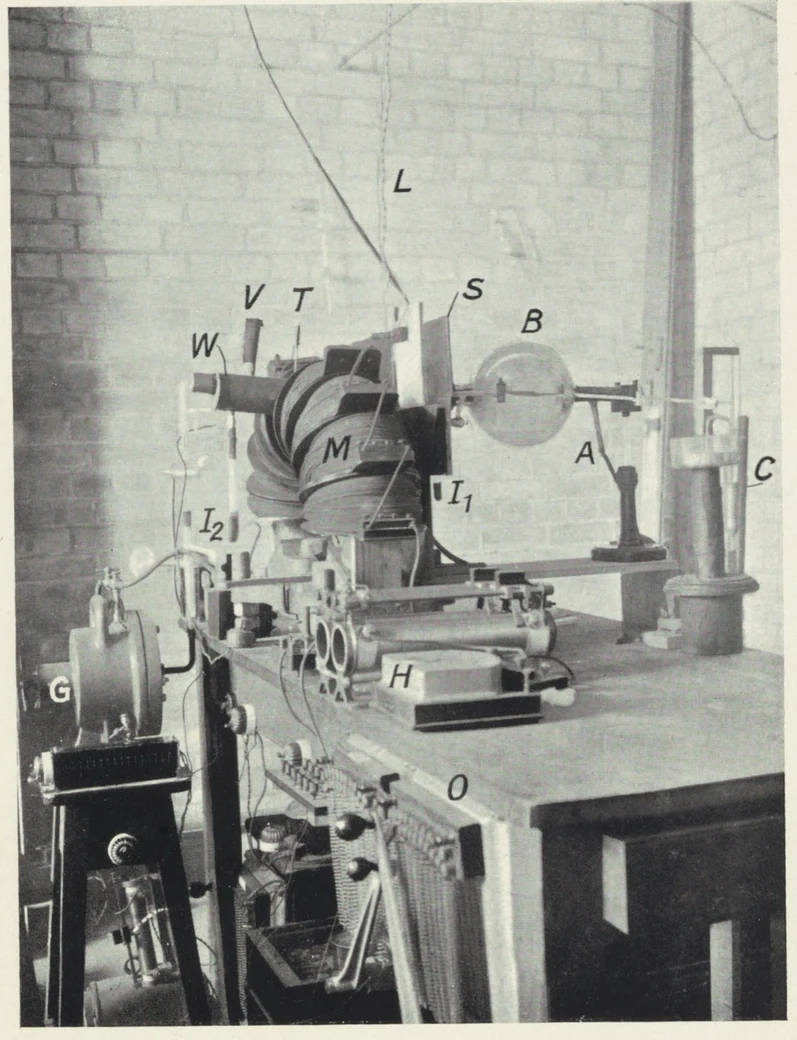

It was built to weigh atoms. It had nothing to do with rocks.
But lead comes in isotopes too — and, crucially, different uranium decay chains produce different lead isotopes. Which means that if you can measure lead isotope ratios precisely, you are no longer estimating the age of a rock. You are reading it.
In the 1930s an American named Alfred Nier rebuilt the instrument into something far more precise, and turned it on lead from ore deposits.
Holmes took Nier's measurements and did the arithmetic, and in 1946 he published an estimate for the age of the Earth of about three billion years. He revised it upward the following year, to three thousand three hundred and fifty million.
Three billion years. Against Kelvin's twenty million. A physicist's instrument for weighing atoms, pointed at a lump of ore, had multiplied the age of the world by more than a hundred.
It was still low — the modern figure of four and a half billion arrives in the 1950s, from meteorites — but it was the right order of magnitude for the first time in human history.
And it mattered for our story in a way that is easy to miss. Because every year you add to the age of the Earth is another year available for slow things to do big work.
§ VII
The Kettle, and What It Was Doing
Now Holmes asked the question everybody else had left alone.
The Earth is full of uranium and thorium and radioactive potassium, decaying away, pouring out heat, and has been for billions of years. Fine. We established that in Episode 3. We said it made the planet a kettle that somebody had left on.
Holmes asked: what is all that heat actually doing?
Because heat does not just sit in a thing making it warmer. Heat moves — and when heat moves through a fluid, it does not move politely.
Put a pot of thick soup on a low flame and watch it before it boils.
It does not simply get warmer all over. It organises itself. Warm soup at the bottom expands, becomes less dense than the soup above it, and rises in slow columns. At the surface it spreads sideways, gives up its heat, cools, gets denser, and sinks again at the edges. Then round it goes.
Nobody stirred it. The pattern assembles itself out of nothing but heat at the bottom and cold at the top. It is called convection, and it is what heated fluids do, always, given the chance.
Holmes proposed that the mantle is doing exactly that.
And you should immediately object. We spent the first half of this episode establishing, by measurement, that the mantle is solid. Solids do not convect. That was the whole problem.
Here is Holmes's answer, and it is the hinge of the entire series.
"Solid" and "flows" are not opposites. They are answers to different questions, and the question that decides between them is how long are you watching for.
A glacier is ice. Hit it with a hammer and it shatters like the solid it is. Watch it for a century and it pours down a valley, bends round obstacles, and behaves in every meaningful way like a very slow river.
Or take pitch — road tar. At room temperature you can smash it. Leave a lump of it in a funnel and come back in ten years and it will have dripped.
The mantle is rock: solid, rigid, able to carry an S-wave across two thousand nine hundred kilometres in eleven minutes. And over ten million years, under its own colossal pressure and its own radioactive heat, that same rock creeps.
Both of those are true. They were never in conflict. It just took somebody to say so.
And the moment you accept it, Jeffreys' objection does not get argued with. It dissolves.
Jeffreys said you cannot plough a granite ship through a steel sea, and he was right — so stop trying to.
The continents are not ships. They are cargo.
Think of a baggage carousel at an airport. The suitcase is not driving itself forward through the rubber belt, shouldering it aside. The suitcase is sitting still. The belt underneath is moving, and the suitcase goes where the belt goes.
The force Wegener could never find was never supposed to be applied to the front of a continent. It is applied underneath the whole of it, by a slow current of creeping rock, and the continent simply rides.
Holmes then followed his own logic and carved new insights.
If two currents rise beneath a continent and spread apart, they will pull that continent in two — and in the widening gap between the halves, molten rock will rise and make new floor. A new ocean, manufactured from below.
And where currents come back together and descend, the floor would be dragged down with them and destroyed.
Stop and look at what he has just described. New ocean floor created where the mantle rises. Old ocean floor consumed where it sinks. Continents carried passively on top.
That is plate tectonics. Not a vague anticipation of it — the actual mechanism, in the right order, with the right engine.
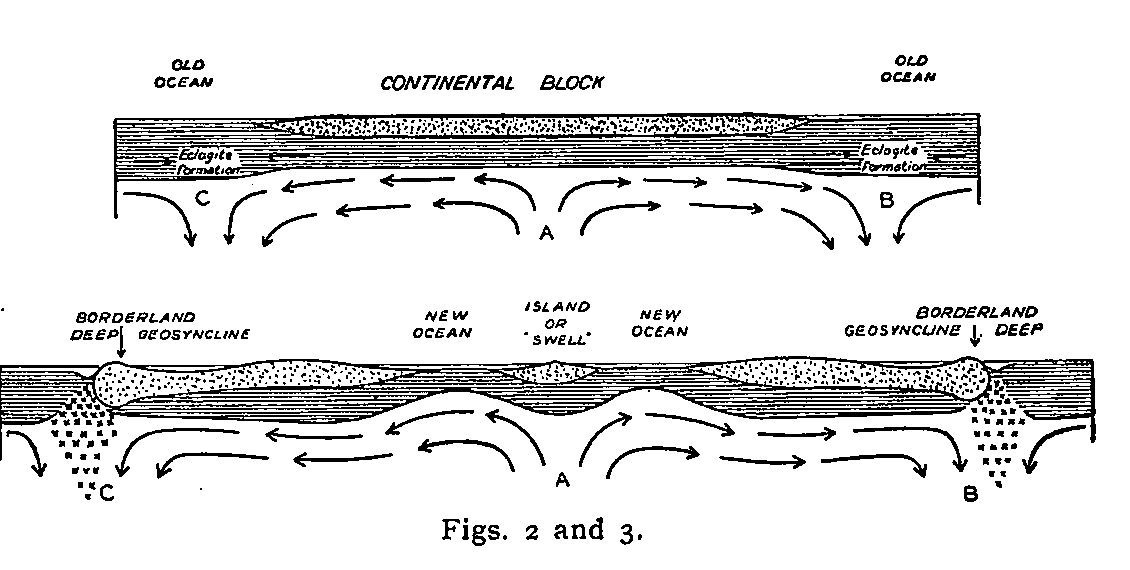
He presented it to the Geological Society of Glasgow in January 1928, and published it in their Transactions in 1931.
§ VIII
A Working Hypothesis of Unusual Promise
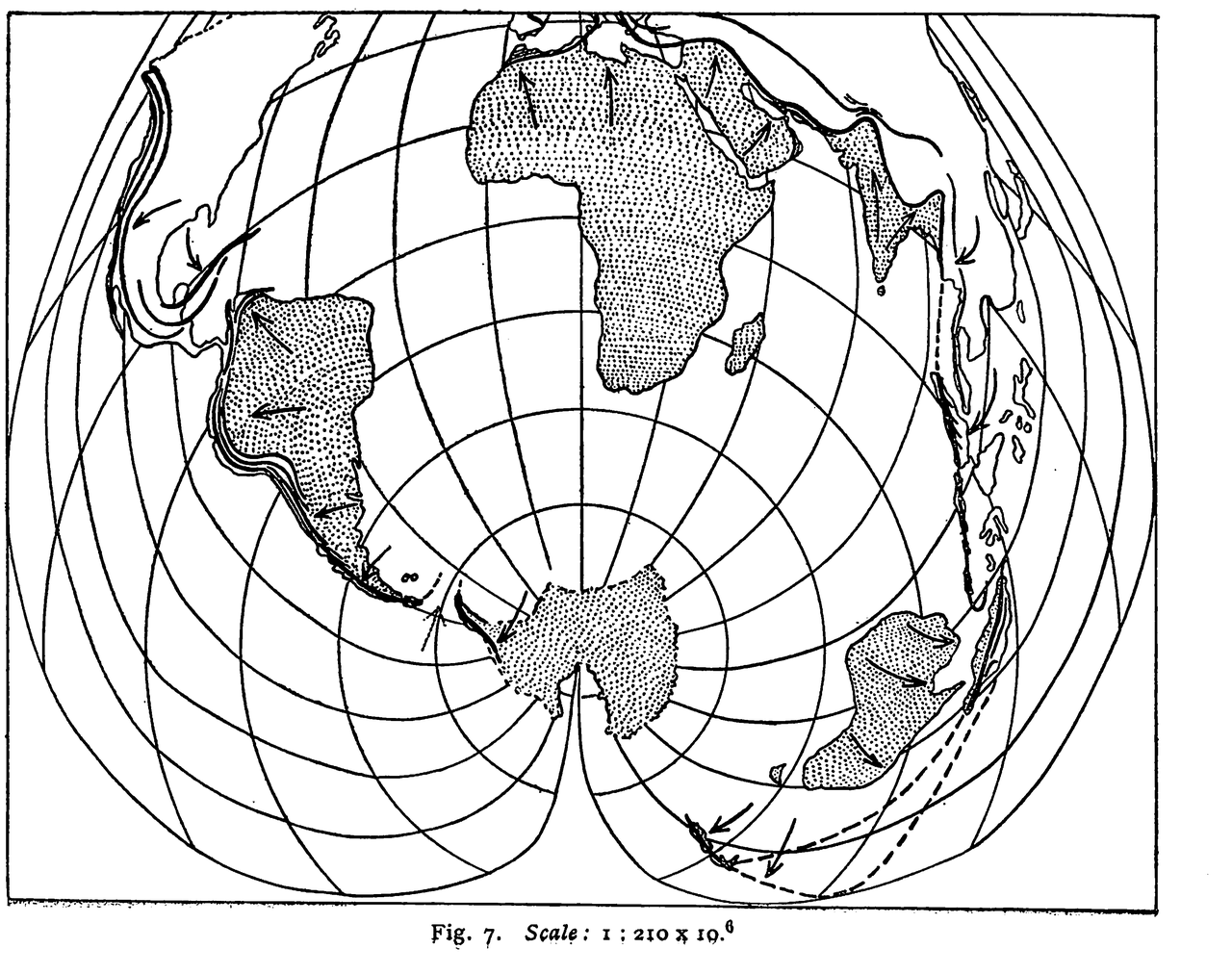
And nothing happened.
Nothing happened for thirty years. It is in the literature the whole time; people read it; a few are impressed; but the textbooks do not change.
And the most interesting thing about that is that Arthur Holmes was not surprised — and you can tell, because of how he chose to end the paper.
He has just written down the engine of the Earth. Here is how he asks you to receive it.
Arthur Holmes, 19311It is not to be expected that the first presentation of a far-reaching hypothesis and its manifold applications can be wholly free from errors. The workings of the inner earth reveal themselves only indirectly, and their actual nature in space and time is certain to be far more complex than can be visualised.
1 · VerbatimA. Holmes, "Radioactivity and Earth Movements", Transactions of the Geological Society of Glasgow, vol. 18 (1931), pp. 559–606, § VII Conclusion, p. 600. doi:10.1144/transglas.18.3.559
He goes on to say that the treatment is almost entirely qualitative, and that it therefore — his words — inevitably stands in need of criticism and quantitative revision.2
2 · Verbatim fragmentHolmes — "stands in need of criticism and quantitative revision"Same paper, § VII, p. 600
And then the last sentence. Not "I have solved it." Not "I claim this." He says that his idea has done well enough to deserve:
Arthur Holmes, 19313...tentative adoption as a working hypothesis of unusual promise.
3 · Verbatim fragmentSame paper, final sentence of § VII, p. 600
Tentative adoption. Unusual promise.
Listen to that again, because it is one of the most honourable paragraphs in this story. He has the mechanism that four decades of argument have been unable to produce — and what he asks for is that you find it promising.
Not because he thinks he's wrong. Because he knows the difference between an idea that fits and an idea that has been tested, and he refuses to blur it. Which is exactly the standard Wegener was held to, and exactly the standard Wegener failed.
So Holmes needed independent evidence.
And here is why he could not have it, and knew he could not have it.
Every observable consequence of his theory is in a hard to get place. New floor made at a rising current — under the sea. Old floor destroyed at a descending one — under the sea. The entire process, from end to end, is happening beneath an average of three and a half kilometres of water, across two thirds of the surface of the planet.
In 1931, the sea floor is the largest unexplored region on Earth. Not poorly mapped. Unmapped. People assumed it was a featureless plain of mud, because there was no reason to think otherwise and no way to find out.
Holmes had written down the answer and filed it somewhere nobody could reach.
It took a world war to get at it.
Specifically, it took submarines — because hunting a submarine means knowing the shape of the water it hides in, and finding a submarine means detecting the dent a steel hull makes in the Earth's magnetic field. Both problems got enormous money and very clever people thrown at them for six years.
And when the war ended there was a surplus of both instruments, a generation of physicists and engineers looking for a problem, and navies still willing to pay.
Next time on The Slow Machine: draining the ocean. What we found when we finally pulled the plug on the sea — a mountain range nobody knew was there, sediment that was far too thin, a sea floor with no old rocks anywhere in it at all — and a woman at a drafting table in New York who was not allowed on the ships, drawing the shape of the bottom of the world.
Every episode of this series has a page at theslowmachine.com — the full transcript, and a table of every quotation in it with the source it came from. If you would like to write to me, the address is michael.goddard@theslowmachine.com.
Apparatus
Quotations, and where they come from
1Holmes — "It is not to be expected that the first presentation..."Verbatim, checked against the printed page image by eye (2026-10-26)A. Holmes, "Radioactivity and Earth Movements", Transactions of the Geological Society of Glasgow, vol. 18 (1931), pp. 559–606, § VII Conclusion, p. 600. doi:10.1144/transglas.18.3.559
2Holmes — "stands in need of criticism and quantitative revision"Verbatim fragment, spoken by the narrator and flagged on air as his words. Checked against the page imageSame paper, § VII, p. 600
3Holmes — "...tentative adoption as a working hypothesis of unusual promise"Verbatim fragment, narrator-framed as his phrase; it is the closing clause of the paper. Checked against the page imageSame paper, final sentence of § VII, p. 600
—Du Toit — no guest read—Du Toit appears descriptively. The Our Wandering Continents dedication to Wegener is referred to, not quoted; if you want it as a read, the exact dedication wording needs checking first
—Mohorovičić — no guest read—Descriptive only